Thursday, February 28, 2019

Foresight Energy LP (FELP) Q4 2018 Earnings Conference Call Transcript

Logo of jester cap with thought bubble.

Image source: The Motley Fool.

Foresight Energy LP  (NYSE:FELP)Q4 2018 Earnings Conference CallFeb. 27, 2019, 2:00 p.m. ET

Contents: Prepared Remarks Questions and Answers Call Participants Prepared Remarks:

Operator

Ladies and gentlemen, thank you for standing by, and welcome to the Fourth Quarter and Full Year 2018 Earnings Call. At this time, all participants are in a listen-only mode. And later we will conduct a question-and-answer session, instructions will be given at that time. (Operator Instructions) As a reminder, this conference is being recorded.

I will now turn the call over to your host, Mr. Jeremy Harrison. Please go ahead, sir.

Jeremy J. Harrison -- Chief Accounting Officer

Thank you, Twanda, and welcome everyone to Foresight Energy's earnings call for the fourth quarter and year ended 2018. With me today is Rob Moore, our President and Chief Executive Officer. Today, we will discuss Foresight Energy's operating and financial results for the fourth quarter and year ended 2018, and update you on the current operations at our coal mines. Following our prepared remarks, we will open up the call to your questions.

Please note that this call contains forward-looking statements that are based upon our current expectations and beliefs concerning future developments and their potential effect on us, and there can be no assurance that the future developments affecting us will be those that we anticipate. Our business and our financial results involve risk and uncertainties that could cause actual results to differ materially from our current expectations. For additional information regarding such risks, please see our annual and quarterly reports filed with the SEC and posted on our website.

During the call today, we will also discuss non-GAAP financial measures, including guidance with respect to adjusted EBITDA. Please refer to our earnings release for reconciliations to the most comparable generally accepted accounting principles for historical periods. Also, this call includes only information that is available to us at this time. To the extent you are listening to this call at a later date, please note that the information may be outdated or incomplete. We undertake no obligation to publicly update or revise any forward-looking statements after the date they are made, whether as a result of new information, future events or otherwise, except as required by law.

I will now turn the call over to Rob Moore. Rob?

Robert D. Moore -- President and Chief Executive Officer

Thank you, Jeremy. Good afternoon, everyone, and thank you for being with us today. This morning, Foresight Energy announced its very good fourth quarter and full year financial results for 2018. During the quarter, Foresight sold over 6.1 million tons of thermal coal and generated total revenue of approximately $299 million, which resulted in adjusted EBITDA of nearly $87 million. These results reflect continued improvement in our year-over-year and sequential quarter sales volumes, sales realization per ton sold and sales revenue. Our fourth quarter results were the capstone of another successful year for Foresight, in which we capitalized on strong export markets and improved domestic spot opportunities to achieve record sales volumes of 23.4 million tons, total revenue of $1.1 billion, and adjusted EBITDA of over $313 million.

During the fourth quarter, we safely and efficiently produced over 6 million tons compared to approximately 5 million tons in the fourth quarter of 2017. Our coal production for calendar year 2018 totaled 23.3 million tons versus 21.2 million tons for the prior year, for an increase of nearly 10%. These levels of production underscore the efficiency and productivity of our underground mines, which places our mines among the most efficient and productive underground mines in the country, as measured on a clean ton per underground man-hour work basis.

For 2018, our two longwall mining complexes; Williamson and Sugar Camp ranked as the second and third most productive mines in the United States, generating 17.4 tons and 16.3 tons per underground man-hour work respectively. On a combined basis, the Foresight mines produced over 17 tons per underground man-hour worked during the fourth quarter and 15.3 tons per underground man-hour worked for the full year. This compares to the national average for underground mines of 4.7 tons per man-hour worked during the fourth quarter and 4.6 for underground man-hour worked for the full year. These high levels of productivity, which drive our industry leading cost structure, allows to consistently maintain cash cost in the low 20s, as evidenced by our year-over-year results.

Our record sales volumes included exports of 2.7 million tons in the fourth quarter and approximately 9 million tons into the export market for the full year 2018, representing 43% and 38% of our sales volumes, respectively. Although, API 2 levels have declined throughout the first quarter of 2019, we have successfully contracted 4.8 million tons into the export market for delivery in 2019, at prices that will yield us solid margins. Furthermore, the export markets remain a viable economic option for us, as physical demand for our high Btu product remains strong and we've had a recent success placing more of our volumes into India, the Middle East and elsewhere around the globe. Relative to the domestic market, despite an extremely mild domestic winter, realizations for our product have been resilient, with a number of coal-fired generating plants at critically low inventory levels.

Updating you on the efforts at our Hillsboro complex, as mentioned on our last quarterly call, the settlement of litigation with NRP provides us with operational flexibility and we've been continuously evaluating the status and future mining operations at Hillsboro's Deer Run Mine. In January of 2019, we resumed production with one continuous miner unit. This continuous miner unit is developing longwall gate entries to allow for the potential resumption of longwall mining. We're currently in the process of hiring personnel, procuring capital equipment and obtaining the necessary approvals from MSHA, to give us the ability to recommence longwall operations. And we believe that we can maintain our development with one continuous miner unit at that operation.

With respect to our Hillsboro insurance recoveries, we continue to pursue all available remedies under our insurance policies related to the combustion event. Due to the ongoing litigation with the insurers that will be the extent of any public comment related to Hillsboro insurance matters at this time.

At this point, I'll turn the call over to Jeremy Harrison for further discussion of our financial results.

Jeremy J. Harrison -- Chief Accounting Officer

Thank you. During 2018, we recognized coal sales revenue of nearly $1.1 billion on sales volumes of 23.4 million tons sold, which generated adjusted EBITDA of $313.6 million. Our 2018 adjusted EBITDA includes $44.1 million of insurance proceeds related to the Hillsboro combustion event, and a $25 million charge related to the settlement with NRP, related to the Hillsboro and Macoupin litigation matters. These results compare to $944 million of coal sales revenue on 21.4 million tons sold and adjusted EBITDA of $293.8 million during the prior year. The increase in coal sales revenue was driven by a nearly 10%, or 2 million ton increase in sales volumes, combined with a $2.71 per ton, or 6% increase in our coal sales realization. The increase in sales volumes and sales realizations per ton were the result of an increased export sales, which experienced more favorable API 2 pricing during 2018, as well as more favorable domestic spot market pricing.

As Rob mentioned, our operating mines continued to be among the most productive underground mines in the country, producing 6.1 million tons during the fourth quarter and 23.3 million tons during the year. These productivity levels translate to cash costs of $22.30 per ton during the fourth quarter and $22.85 for the full year. Our transportation cost increased $66.5 million in 2018, when compared to 2017. This increase was driven by increased sales volumes and a higher percentage of our sales going to the export market, which have higher associated transportation expense.

From a cash flow perspective, during 2018, we generated operating cash flows of $133 million and ended the quarter with a total liquidity of approximately $121 million. Capital expenditures totaled $84.1 million. We paid down $69.1 million on our long-term debt and capital lease obligations, and we paid $18.1 million in distributions to our common unit holders.

I'll now turn the call back over to Rob for additional comments before we take your questions.

Robert D. Moore -- President and Chief Executive Officer

On the strength of our mining operations during 2018, Foresight generated $39.2 million of excess cash flow and was less than four times levered as defined in our March 2017 credit and guaranty agreement. Pursuant to the terms of the credit agreement, we will be sweeping to our first-lien lenders 50% of the excess cash flow, or approximately $19.6 million. The retained portion of excess cash flow of $19.6 million will be available for distribution to our common unitholders in 2019. The partnership intends to utilize its excess cash flow for debt repayment and distribution to our common unit holders.

To that end, based on the financial results for the fourth quarter, the results of our excess cash flow calculation for 2018 and our outlook on liquidity and operations for 2019 and beyond, the Board of Directors of our general partner has elected to declare a quarterly distribution from the retained portion of excess cash flow of $0.06 per unit, payable exclusively to the holders of the FELP common units. This represents a 6% increase per unit over our prior quarterly distribution. The distribution will be paid on March 29th, to common unit holders of record as of March 19th. As we have mentioned on previous calls, future distributions will be subject to Board approval and will be based on a number of factors, including our leverage levels, market conditions, excess cash flow remaining after required excess cash flow sweeps and our projected future financial and operating performance.

In concluding our prepared remarks, we are initiating guidance for sales volumes, adjusted EBITDA and capital expenditures for 2019. Based on our current contracted position and outlook for the domestic and export coal markets, we expect 2019 sales volumes to total between 22 million tons and 23 million tons, with approximately 7 million tons being sold to the export market. At these volumes, we expect to generate adjusted EBITDA ranging between $300 million to $340 million. Based on our current operating plans and recent capital spending, we expect 2019 annual capital expenditures to total between $80 million and $95 million, which includes capital expenditures related to Hillsboro.

With that, we will open up the lines and take your questions. Operator?

Questions and Answers:

Operator

(Operator Instructions) And our first question will come from the line of Matthew Fields with Bank of America. Your line is open.

Matthew Fields -- Bank of America -- Analyst

Hey, everyone. Just wanted to talk, first off, about your export versus domestic tonnage. So if you delivered 9 million tons into the export market this year, that means you sold 14.5 million domestically, which is down about 8% from 2017. Can you just talk about the domestic market and your sort of contracted positions with utilities? And obviously API 2 was attractive in 2018, but does the dynamic go forward where you're going to continue to sort of offload tons, because you're failing to find a home domestically, or is it purely kind of opportunistic?

Robert D. Moore -- President and Chief Executive Officer

So we're looking at it Matt, purely as opportunistic. We have right now, for 2019, about 68% of our book on contract. And if you include options that we believe utilities will exercise and those would be domestic utilities here, we have about 73% of our volumes under contract. We're able to find homes for our product, domestically, and in the export market, and we are going to toggle between the markets that provide us with the best overall realizations, mindful of the benefit of having long-term relationships with our domestic customers. So there's definitely a balance and we'll be opportunistic in that respect.

Matthew Fields -- Bank of America -- Analyst

If I take the midpoint of the 22 million to 23 million guidance and subtract it with 7 million export tons that's 15.5 million domestically, which is actually up 1 million tons. Is that a new client, is that existing sort of clients reupping, or is that just kind of going into the year, kind of hopeful sense of whether you might play out? Can you give us a little color on that Increase in domestic tons which would be the first one in a while?

Robert D. Moore -- President and Chief Executive Officer

It is a combination of existing markets that we serve and some new markets. What we're seeing is as utility customers are unable to find coal that they have historically been able to source, they are looking outside of the box and coming up with what I'll refer to as blends of coal, that allow them to meet the specifications of their specific boilers, and we're trying to take advantage of that where we can. Given our low-cost platform, we're able to blend our products with other coals that allow that other product maybe to be stretched a little bit more and it's allowing us to hit some new markets. So we like our position as it relates to the cost at Foresight and the flexibility we have transportation-wise to hit new markets and we're going to continue to target those opportunities.

Operator

Next we'll go to the line of Nick Jarmoszuk with Stifel. Your line is open, sir.

Nicholas Jarmoszuk -- Stifel -- Analyst

Hi, Rob and Jeremy.

Robert D. Moore -- President and Chief Executive Officer

Hi, Nick.

Nicholas Jarmoszuk -- Stifel -- Analyst

Question for you on the export book. Have you hedged any of the tons?

Robert D. Moore -- President and Chief Executive Officer

Yes. The total amount that I've indicated, the 4.8 million, that's on the book right now, it's hedged.

Nicholas Jarmoszuk -- Stifel -- Analyst

Okay, can you give us that price?

Robert D. Moore -- President and Chief Executive Officer

No, I can't.

Nicholas Jarmoszuk -- Stifel -- Analyst

Is it higher than currents spot levels?

Robert D. Moore -- President and Chief Executive Officer

It is.

Nicholas Jarmoszuk -- Stifel -- Analyst

Okay. So should we think about, relative to where that hedge price is, we're going to have the sulfur discount is lower, freight is lower. Could you see some very attractive margins in the first quarter as a result of where the spot market has gone on API 2?

Robert D. Moore -- President and Chief Executive Officer

I mean, we -- in terms of the Q1, Nick, we had the majority of our volumes hedged, Q1, and even going into Q2. So we didn't have a lot of opportunity to necessarily plan the spot market. The other thing that's limiting export spot market opportunities are the river conditions and the port conditions, which has slowed traffic in and out of the port. So not a lot of, what I'll call, spot market -- spot export market opportunities. But I will tell you that I think that there could be some opportunities as things start to clear up at the port, given the Mississippi River conditions right now, and the inability of certain suppliers to actually get to load point. And I think those opportunities could arise in the March time frame and April time frame.

Nicholas Jarmoszuk -- Stifel -- Analyst

And a question for you on the outlook for Hillsboro. How do you guys weigh the risk of that additional tonnage repricing in the ILB market versus the opportunity for the additional tonnage?

Robert D. Moore -- President and Chief Executive Officer

So when I think about Hillsboro and the effect that it could have on ILB, I think people may not understand just where that product can report. I think that there is an ability to have that product being blended in with our existing production, such that we're not really repricing any new volumes into ILB. We have the ability to take that product to the East Coast in significant volumes. And we also have the ability to move that coal into the export market. So as I think about where I'm going to place Hillsboro, I'd think we can move quite a bit of that volume away from the ILB markets, such that it doesn't have a direct effect, and obviously, it's going to -- some of that is going to come in. But when you also then take into consideration operations that are closing or have closed and the lack of supply that I think you're going to see, even though you've got a couple of our competitors coming on with some additional production, I think when you look at the overall supply and balance -- demand balance, there's a place for that product and I do not believe it's going to result in the deterioration of ILB prices.

Operator

Next we'll go to the line of Jeff Menapace with FTN Financial. Your line is open.

Jeff Menapace -- FTN Financial -- Analyst

Good afternoon, guys. With respect to Hillsboro, so obviously -- or it seemed like the settlement was the impetus for -- within our peers, the impetus for getting that restarted again. What's the status of the combustion event? Is that no longer -- is that resolved, no longer an issue?

Robert D. Moore -- President and Chief Executive Officer

It is no longer an issue. We sealed up the entire longwall district in which the event occurred. We are now in a new longwall district. We have resumed the development of a panel that existed in that new district. And as I indicated, we are working with the regulators to gain a ventilation plan that allows us to ventilate the longwall.

Jeff Menapace -- FTN Financial -- Analyst

Okay, terrific. And then with respect to EBITDA guidance, if I want to normalize the reported EBITDA, the $313.6 million for the NRP settlement and insurance recoveries, I should subtract the 20 (ph) -- I want to make sure my numbers are right, $25 million for NRP, and I think the $43 million was the addition to operating income from the insurance recovery. So my normalized number is $295.6 million. Is that a good number, normalized number?

Robert D. Moore -- President and Chief Executive Officer

Yes, you are definitely in the ballpark there. That's right.

Jeff Menapace -- FTN Financial -- Analyst

Okay, great. Thank you very much.

Robert D. Moore -- President and Chief Executive Officer

Okay.

Operator

(Operator Instructions) Next we'll go to the line of Mayur Kenia with IWD Capital Management. Your line is open.

Mayur Kenia -- IWD Capital Management -- Analyst

Hi, guys. Thanks for taking the questions. One question I had was, does the adjusted EBITDA guidance include any insurance recoveries?

Robert D. Moore -- President and Chief Executive Officer

The adjusted 2019 does not.

Mayur Kenia -- IWD Capital Management -- Analyst

Okay, thanks. And in terms of the CapEx guidance, does that include any longwall equipment at Hillsboro?

Robert D. Moore -- President and Chief Executive Officer

Yes, it does include some of the longwall equipment.

Mayur Kenia -- IWD Capital Management -- Analyst

Okay, great.

Robert D. Moore -- President and Chief Executive Officer

It does not include the longwall shields.

Mayur Kenia -- IWD Capital Management -- Analyst

Okay, all right. And then in terms of -- could you provide a range for excess cash flow for 2019?

Robert D. Moore -- President and Chief Executive Officer

In terms of 2019, if you just work off of our midpoints what we've outlined as the CapEx and what our cash interest is, you're going to see excess cash flow of around $75 million to $80 million for the year.

Mayur Kenia -- IWD Capital Management -- Analyst

Okay, great. And then thank you for the color around Hillsboro. Could I get the impact on cost per ton from Hillsboro in the quarter?

Robert D. Moore -- President and Chief Executive Officer

For the fourth quarter?

Mayur Kenia -- IWD Capital Management -- Analyst

Yes.

Jeremy J. Harrison -- Chief Accounting Officer

It's been about $0.50 a ton all year.

Mayur Kenia -- IWD Capital Management -- Analyst

Okay, all right. And then I guess the last question, do you know what the actual specific secured leverage ratio was at the end of Q4?

Jeremy J. Harrison -- Chief Accounting Officer

It's 3.90 times.

Mayur Kenia -- IWD Capital Management -- Analyst

Okay, great. That's it from me. Thank you for the answers.

Robert D. Moore -- President and Chief Executive Officer

Okay.

Operator

And next we'll go to the line of Michal Marczak with DoubleLine Capital. Your line is open.

Michal Marczak -- DoubleLine Capital -- Analyst

Hey, guys. The previous gentlemen's questions are most of the ones I had. Just a quick follow-up. The excess cash flow that you mentioned, Rob is $75 million to $85 million, is that the total number or is that kind of the 50% of the kind of potential cash flow sweep that would go down to paying down the term loan?

Robert D. Moore -- President and Chief Executive Officer

Yeah. So that's the total number based on the guidance that we've delivered.

Michal Marczak -- DoubleLine Capital -- Analyst

Got it. Thanks very much.

Robert D. Moore -- President and Chief Executive Officer

Okay.

Operator

And at this time, gentlemen, there are no further questions in the queue.

Robert D. Moore -- President and Chief Executive Officer

Very good. We appreciate everyone's time today, and look forward to talking to you next quarter.

Operator

Ladies and gentlemen, that does conclude our conference for today. Thank you for your participation and for using AT&T Executive TeleConference. You may now disconnect.

Duration: 24 minutes

Call participants:

Jeremy J. Harrison -- Chief Accounting Officer

Robert D. Moore -- President and Chief Executive Officer

Matthew Fields -- Bank of America -- Analyst

Nicholas Jarmoszuk -- Stifel -- Analyst

Jeff Menapace -- FTN Financial -- Analyst

Mayur Kenia -- IWD Capital Management -- Analyst

Michal Marczak -- DoubleLine Capital -- Analyst

More FELP analysis

Transcript powered by AlphaStreet

This article is a transcript of this conference call produced for The Motley Fool. While we strive for our Foolish Best, there may be errors, omissions, or inaccuracies in this transcript. As with all our articles, The Motley Fool does not assume any responsibility for your use of this content, and we strongly encourage you to do your own research, including listening to the call yourself and reading the company's SEC filings. Please see our Terms and Conditions for additional details, including our Obligatory Capitalized Disclaimers of Liability.

Friday, February 22, 2019

Career Education (CECO) Updates Q1 2019 Earnings Guidance

Career Education (NASDAQ:CECO) updated its first quarter 2019 earnings guidance on Wednesday. The company provided earnings per share guidance of $0.30-0.32 for the period, compared to the Thomson Reuters consensus earnings per share estimate of $0.30. Career Education also updated its FY 2019 guidance to $1.11-1.15 EPS.

A number of research firms recently issued reports on CECO. Zacks Investment Research raised Career Education from a hold rating to a buy rating and set a $14.00 price objective for the company in a research report on Wednesday, January 16th. Barrington Research started coverage on Career Education in a research report on Sunday, December 9th. They set an outperform rating and a $13.49 price objective for the company. BidaskClub upgraded Career Education from a sell rating to a hold rating in a report on Wednesday, October 24th. Finally, ValuEngine lowered Career Education from a buy rating to a hold rating in a report on Friday, November 2nd. Four research analysts have rated the stock with a hold rating and two have assigned a buy rating to the company’s stock. The stock currently has a consensus rating of Hold and an average price target of $18.38.

Get Career Education alerts:

NASDAQ CECO traded up $0.07 during trading on Wednesday, hitting $13.94. 489,747 shares of the company traded hands, compared to its average volume of 245,019. Career Education has a 12 month low of $11.01 and a 12 month high of $19.07. The firm has a market cap of $967.57 million, a P/E ratio of 44.97, a price-to-earnings-growth ratio of 1.02 and a beta of 1.75.

In other news, SVP Jeffrey David Ayers sold 10,903 shares of Career Education stock in a transaction dated Thursday, January 24th. The stock was sold at an average price of $13.00, for a total value of $141,739.00. The transaction was disclosed in a document filed with the SEC, which can be accessed through this hyperlink. Also, SVP Andrew Hurst sold 16,531 shares of Career Education stock in a transaction dated Monday, December 3rd. The stock was sold at an average price of $14.00, for a total value of $231,434.00. The disclosure for this sale can be found here. Over the last 90 days, insiders have sold 38,352 shares of company stock worth $512,814. Corporate insiders own 5.70% of the company’s stock.

TRADEMARK VIOLATION NOTICE: This news story was originally reported by Ticker Report and is owned by of Ticker Report. If you are reading this news story on another website, it was stolen and reposted in violation of international copyright laws. The correct version of this news story can be read at https://www.tickerreport.com/banking-finance/4166841/career-education-ceco-updates-q1-2019-earnings-guidance.html.

Career Education Company Profile

Career Education Corporation operates colleges, institutions, and universities that provide education to student population in various career-oriented disciplines through online, campus based, and blended learning programs in the United States. The company operates through three segments: Colorado Technical University (CTU), American InterContinental University (AIU), and All Other Campuses.

Featured Article: Technical Analysis

Thursday, February 21, 2019

Intuit Earnings: Will Strong Growth Persist?

The pressure will be on when financial software company Intuit (NASDAQ:INTU) reports its fiscal second-quarter results on Feb. 21. Shares are up 19% year to date -- and that's on top of a 25% gain last year. The stock's run-up reflects investors' bullishness toward the company's fast-growing online ecosystem revenue and its improving profitability.

Can Intuit keep impressing investors when it reports results later this week? Ahead of the company's fiscal second-quarter update, here's a preview of some key areas they will want to check on.

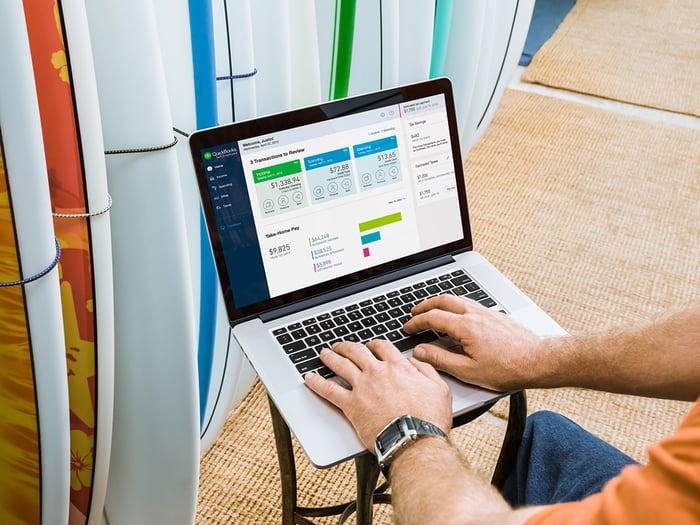
A small business owner using QuickBooks Online on a laptop

Quickbooks Online. Image source: Intuit.

Revenue growth

For the entire fiscal year of 2018, which ended on July 21 of last year, Intuit saw its revenue growth accelerate. Revenue during the period increased 15% year over year -- up from 10% growth in fiscal 2017. But the company's year-over-year revenue growth decelerated in its first quarter of fiscal 2019, rising 12% (down from 17% year-over-year growth in the company's fourth quarter of fiscal 2018).

Investors should look to see if Intuit was able to stop this trend of decelerating growth in its fiscal second quarter. But pulling this off will require revenue to come in above management's guidance for fiscal second-quarter revenue between $1.47 billion and $1.49 billion. Revenue at these levels implies 10% to 11% year-over-year growth.

Non-GAAP earnings per share

Management expects its trend of rapidly improving profitability to persist in its fiscal second quarter. The company guided for non-GAAP earnings per share between $0.85 and $0.88, up from $0.35 in the year-ago period.

Online ecosystem revenue growth

Intuit's online ecosystem revenue, which encapsulates revenue from the company's online small-business and self-employed group offerings, has been on a tear. Online ecosystem revenue increased by 43% and 42% in Intuit's fourth quarter of fiscal 2018 and first quarter of fiscal 2019, respectively.

Management has been telling investors that it believes its online ecosystem revenue is "the best measure of the health and success of our strategy going forward ..."

Over the long haul, management says it expects online ecosystem revenue growth to continue at a rate above 30%. But given how strong the growth from the revenue category has been recently, investors should expect growth closer to 40% in Q4.

Consumer revenue

Investors also shouldn't overlook revenue from Intuit's consumer products. Its consumer revenue, which is primarily driven by its do-it-yourself TurboTax income tax preparation service, increased 22% year over year in the company's first quarter of fiscal 2019. The segment also includes revenue from Mint and Turbo -- two online products aimed at helping consumers improve their financial health.

Investors should look for 15% to 25% year-over-year growth in consumer revenue in Q2.

TurboTax unit sales

While investors should look for a similar growth rate from the segment in fiscal Q2, they'll want to pay particularly close attention to the company's first of two tax-season updates on its consumer tax offerings -- an update Intuit plans to release alongside its fourth-quarter update. In this update, investors will see how many TurboTax units the company sold during the beginning of the tax season.

Last year, Intuit announced a 1% year-over-year increase in TurboTax unit sales, consisting of a 5% decline in TurboTax desktop units and a 3% increase in TurboTax online units. Given the company's efforts to ramp up its TurboTax Live offering, investors should look for an acceleration in TurboTax online unit sales growth.

Monday, February 18, 2019

Top 5 Small Cap Stocks To Buy Right Now

tags:ATAI,MOBI,CNR,FCEL,ACHN,

Small cap upscale apparel brand retailer Vince Holding Corp (NYSE: VNCE) reported Q1 2017 financial results before the market opened this morning. Net sales decreased 14.2% to $58.0 million as wholesale segment sales decreased 20.9% to $35.4 million, primarily due to a reduction in full-price orders as a result of the elimination of the Company's summer delivery, and as direct-to-consumer segment sales fell 1.0% to $22.6 million. Comparable sales decreased 5.7%, including e-commerce sales, due to a decrease in average order value.

The net loss was $9.3 million versus a net loss of $1.9 million (the Q1 2017 net loss does not include a benefit from income taxes due to the offsetting impact of the tax valuation allowance). The Company ended the first quarter of 2017 with $15.4 million in cash and cash equivalents and $66.1 million of borrowings under its debt agreements.

Top 5 Small Cap Stocks To Buy Right Now: ATA Inc.(ATAI)

Advisors' Opinion:
  • [By Paul Ausick]

    ATA Inc. (NASDAQ: ATAI) traded down about 14% Monday to set a new 52-week low of $0.82, based on revalued shares that closed at $0.72 on Friday but traded up about 250% on Monday at $2.53. Volume was more than 200 times the daily average of around 42,000. You’re on your own here to figure this one out.

Top 5 Small Cap Stocks To Buy Right Now: Sky-mobi Limited(MOBI)

Advisors' Opinion:
  • [By Ethan Ryder]

    Mobius (CURRENCY:MOBI) traded 1.2% lower against the dollar during the 1-day period ending at 14:00 PM E.T. on August 21st. In the last week, Mobius has traded down 1.1% against the dollar. One Mobius token can now be bought for about $0.0291 or 0.00000452 BTC on popular cryptocurrency exchanges including GOPAX, BitMart, Gate.io and Stellar Decentralized Exchange. Mobius has a total market capitalization of $11.23 million and approximately $78,528.00 worth of Mobius was traded on exchanges in the last 24 hours.

  • [By Logan Wallace]

    Mobius (CURRENCY:MOBI) traded 12.4% lower against the US dollar during the 24 hour period ending at 17:00 PM E.T. on September 25th. One Mobius token can now be bought for approximately $0.0265 or 0.00000414 BTC on major cryptocurrency exchanges including Gate.io, Kucoin, BitMart and GOPAX. Over the last week, Mobius has traded up 8.8% against the US dollar. Mobius has a market cap of $10.22 million and approximately $69,762.00 worth of Mobius was traded on exchanges in the last day.

  • [By Logan Wallace]

    Media coverage about Sky-mobi (NASDAQ:MOBI) has trended somewhat positive this week, according to Accern Sentiment. The research group ranks the sentiment of media coverage by analyzing more than twenty million news and blog sources. Accern ranks coverage of public companies on a scale of -1 to 1, with scores nearest to one being the most favorable. Sky-mobi earned a news impact score of 0.06 on Accern’s scale. Accern also assigned news stories about the software maker an impact score of 45.6853785900783 out of 100, meaning that recent media coverage is somewhat unlikely to have an impact on the company’s share price in the near term.

  • [By Logan Wallace]

    Mobius (CURRENCY:MOBI) traded up 0.1% against the dollar during the 24 hour period ending at 18:00 PM ET on February 11th. In the last week, Mobius has traded 3.1% lower against the dollar. One Mobius token can now be bought for approximately $0.0095 or 0.00000260 BTC on exchanges including OTCBTC, Gate.io, Stellar Decentralized Exchange and BitMart. Mobius has a total market capitalization of $4.89 million and approximately $19,445.00 worth of Mobius was traded on exchanges in the last day.

Top 5 Small Cap Stocks To Buy Right Now: China Metro-Rural Holdings Limited(CNR)

Advisors' Opinion:
  • [By Shane Hupp]

    Wall Street analysts expect that Canadian National Railway (NYSE:CNI) (TSE:CNR) will announce $1.02 earnings per share (EPS) for the current quarter, according to Zacks Investment Research. Seven analysts have provided estimates for Canadian National Railway’s earnings, with the highest EPS estimate coming in at $1.06 and the lowest estimate coming in at $0.97. Canadian National Railway reported earnings per share of $1.00 in the same quarter last year, which would suggest a positive year over year growth rate of 2%. The company is expected to announce its next quarterly earnings results on Tuesday, July 24th.

  • [By Ethan Ryder]

    State of Tennessee Treasury Department lessened its stake in shares of Canadian National Railway (NYSE:CNI) (TSE:CNR) by 1.6% in the 1st quarter, according to the company in its most recent 13F filing with the SEC. The institutional investor owned 842,775 shares of the transportation company’s stock after selling 13,507 shares during the quarter. State of Tennessee Treasury Department owned about 0.11% of Canadian National Railway worth $61,565,000 as of its most recent filing with the SEC.

  • [By Logan Wallace]

    Canadian National Railway (NYSE:CNI) (TSE:CNR) – Analysts at Seaport Global Securities issued their Q1 2019 EPS estimates for shares of Canadian National Railway in a research note issued to investors on Wednesday, January 30th. Seaport Global Securities analyst M. Levin expects that the transportation company will earn $0.96 per share for the quarter. Seaport Global Securities also issued estimates for Canadian National Railway’s Q2 2019 earnings at $1.26 EPS, Q3 2019 earnings at $1.27 EPS and Q4 2019 earnings at $1.26 EPS.

  • [By Shane Hupp]

    Canadian National Railway (TSE:CNR) (NYSE:CNI) had its target price upped by investment analysts at CIBC from C$116.00 to C$120.00 in a research report issued on Friday. CIBC’s price objective suggests a potential upside of 3.54% from the stock’s current price.

Top 5 Small Cap Stocks To Buy Right Now: FuelCell Energy Inc.(FCEL)

Advisors' Opinion:
  • [By Shane Hupp]

    FuelCell Energy (NASDAQ: FCEL) is one of 25 public companies in the “Miscellaneous electrical machinery, equipment, & supplies” industry, but how does it contrast to its peers? We will compare FuelCell Energy to related companies based on the strength of its risk, dividends, earnings, valuation, profitability, analyst recommendations and institutional ownership.

  • [By Ethan Ryder]

    FuelCell Energy (NASDAQ: FCEL) and Integer (NYSE:ITGR) are both oils/energy companies, but which is the superior investment? We will contrast the two companies based on the strength of their analyst recommendations, dividends, earnings, profitability, valuation, institutional ownership and risk.

  • [By Paul Ausick]

    FuelCell Energy Inc. (NASDAQ: FCEL) posted a gain of 4.2% in short interest during the two-week period. Some 10.29 million shares were short as of September 14. The stock closed at $1.13 on Tuesday, up about 5.6% for the day, in a 52-week range of $1.00 to $2.49. Shares traded down about 7.6% in the short interest period, and days to cover fell from 12 to nine.

Top 5 Small Cap Stocks To Buy Right Now: Achillion Pharmaceuticals Inc.(ACHN)

Advisors' Opinion:
  • [By Max Byerly]

    Achillion Pharmaceuticals, Inc. (NASDAQ:ACHN) shares shot up 8.6% on Thursday . The company traded as high as $3.59 and last traded at $3.54. 1,383,547 shares changed hands during trading, a decline of 5% from the average session volume of 1,456,445 shares. The stock had previously closed at $3.26.

  • [By Logan Wallace]

    Get a free copy of the Zacks research report on Achillion Pharmaceuticals (ACHN)

    For more information about research offerings from Zacks Investment Research, visit Zacks.com

  • [By Ethan Ryder]

    Achillion Pharmaceuticals (NASDAQ:ACHN) – Research analysts at B. Riley reduced their FY2018 EPS estimates for shares of Achillion Pharmaceuticals in a research note issued to investors on Wednesday, May 2nd. B. Riley analyst M. Kumar now anticipates that the biopharmaceutical company will earn ($0.58) per share for the year, down from their previous estimate of ($0.55). B. Riley has a “Neutral” rating and a $3.50 price objective on the stock. B. Riley also issued estimates for Achillion Pharmaceuticals’ FY2019 earnings at ($0.64) EPS, FY2020 earnings at ($0.71) EPS, FY2021 earnings at ($0.70) EPS and FY2022 earnings at ($0.84) EPS.

  • [By Lisa Levin] Gainers Avenue Therapeutics, Inc. (NASDAQ: ATXI) rose 29.4 percent to $5.50 in pre-market trading after the company disclosed that its first pivotal Phase 3 trial of IV tramadol achieved the primary and key secondary endpoints. MB Financial, Inc. (NASDAQ: MBFI) rose 16.8 percent to $51.00 in pre-market trading. Fifth Third Bancorp (NASDAQ: FITB) agreed to acquire MB Financial for $54.70 per share in cash and stock. LiveXLive Media, Inc. (NASDAQ: LIVX) rose 9.3 percent to $5.40 in pre-market trading after falling 28.92 percent on Friday. Celyad SA (NASDAQ: CYAD) shares rose 9 percent to $29.30 in pre-market trading after climbing 3.26 percent on Friday. Ethan Allen Interiors Inc. (NYSE: ETH) rose 6.7 percent to $26.40 in pre-market trading after gaining 1.64 percent on Friday. Achillion Pharmaceuticals, Inc. (NASDAQ: ACHN) rose 5.4 percent to $3.90 in pre-market trading after gaining 3.06 percent on Friday. Acacia Communications, Inc. (NASDAQ: ACIA) rose 5.2 percent to $34.70 in pre-market trading after gaining 1.38 percent on Friday. Westinghouse Air Brake Technologies Corporation (NYSE: WAB) rose 5.1 percent to $100 in pre-market trading. General Electric Company (NYSE: GE) agreed to merge its transportation unit with Wabtec. Sunrun Inc. (NASDAQ: RUN) shares rose 4.7 percent to $11.50 in pre-market trading. Nasdaq, Inc. (NASDAQ: NDAQ) shares rose 4.3 percent to $93.98 in the pre-market trading session. LaSalle Hotel Properties (NYSE: LHO) shares rose 4.2 percent to $33.25 in pre-market trading. Blackstone Group LP (NYSE: BX) will buy LaSalle Hotel Properties in a $4.8 billion deal, Bloomberg reported. Monro, Inc. (NASDAQ: MNRO) shares rose 4 percent to $58.35 in pre-market trading as the company posted upbeat quarterly earnings and disclosed that it has acquired Free Service Tire. HUYA Inc. (NYSE: HUYA) rose 3.7 percent to $19.75 in pre-market trading after falling 4.80 percent on Friday.

    Find out what's going

  • [By Ethan Ryder]

    Get a free copy of the Zacks research report on Achillion Pharmaceuticals (ACHN)

    For more information about research offerings from Zacks Investment Research, visit Zacks.com

Sunday, February 17, 2019

These 2 REITs Just Earned Our Highest Score – One Pays Nearly 12%

This site uses Akismet to reduce spam. Learn how your comment data is processed.

REITsForecasts for global economic growth are dropping dramatically. The United States is now seen as a safe haven island unto itself.

Now, investors are buying dollars, which has pushed yields on debt securities even lower.

These machinations have led investors to move to riskier high-yield investments, which has in turn lifted stocks significantly in the first two months of 2019.

Wall Street often has a crude sense of humor knowing that such "risk-on" trades may be coming at exactly the wrong time.

First, analysts are unclear about corporate earnings in 2019. They have no clue if there will be any meaningful growth in earnings.

We already know GDP will come in lower than a year prior.

$1 Cash Course: Tom Gentile is offering a rare opportunity to learn how to amass a constant stream of extra cash – year after year. And he's going to teach you how to do it entirely on your own. Learn more…

So how can it be that stock prices are going higher?

In some ways, it makes sense. There is no other place for capital to flow.

Investors interested in safer alternatives to buying stocks just as the economy is teetering should be looking at real estate investment trusts, or REITs.

REITs are even more attractive for investors looking for income.

Retail sales in December collapsed, pushing bond yields even lower.

The stars are aligning perfectly for investing in REITs, and the Money Morning Stock VQScore™ system just identified two that rank highly. Best of all, one pays a dividend yield of over 12%.

These are the two best REITs to buy today…

Best REITs to Buy Now, No. 2:

All the gyrations in the economy may be interpreted negatively in the near term, but REIT investors are more focused on the long term.

What matters most to the REIT investor is reliability of cash flow.

A stable cash flow is required to pay the dividends that make REITs so attractive today.

Sunstone Hotel Investors Inc. (NYSE: SHO) has investments in 22 hotels that operate under recognizable brands like Marriott, Hilton, and Hyatt.

Those recognizable names provide stability to Sunstone in regards to cash flow.

Analysts expect Sunstone to generate $1.5 billion in revenue in 2018 and $1.3 billion in revenue in 2019.

That incremental decline in sales is one reason shares of Sunstone have declined 5% since November of 2018.

But with a 5% dividend yield, investors in Sunstone are nearly doubling the current yield on the 10-year Treasury.

That's huge outperformance that should be exploited in the current environment.

Now, here's the top REIT to buy today…

Best REITs to Buy Now, No. 1:

Join the conversation. Click here to jump to comments…

Saturday, February 16, 2019

Top Value Stocks To Invest In 2019

tags:EME,ANSS,VTR,

Synlogic (NASDAQ:SYBX) has been given a $20.00 price objective by investment analysts at HC Wainwright in a research note issued to investors on Friday. The firm currently has a “buy” rating on the biotechnology company’s stock. HC Wainwright’s price objective suggests a potential upside of 50.72% from the company’s current price.

Several other analysts have also recently issued reports on SYBX. Zacks Investment Research raised shares of Synlogic from a “sell” rating to a “hold” rating in a report on Saturday, January 20th. Piper Jaffray initiated coverage on shares of Synlogic in a report on Monday, January 29th. They issued an “overweight” rating and a $16.00 price target on the stock. Finally, ValuEngine cut shares of Synlogic from a “sell” rating to a “strong sell” rating in a report on Friday, February 2nd. Two research analysts have rated the stock with a sell rating and four have given a buy rating to the company’s stock. Synlogic has an average rating of “Hold” and an average price target of $20.00.

Top Value Stocks To Invest In 2019: EMCOR Group, Inc.(EME)

Advisors' Opinion:
  • [By Logan Wallace]

    Chicago Equity Partners LLC lifted its stake in shares of Emcor Group Inc (NYSE:EME) by 6.4% during the second quarter, according to its most recent disclosure with the Securities and Exchange Commission. The firm owned 145,359 shares of the construction company’s stock after acquiring an additional 8,750 shares during the quarter. Chicago Equity Partners LLC’s holdings in Emcor Group were worth $11,073,000 as of its most recent filing with the Securities and Exchange Commission.

  • [By Shane Hupp]

    Get a free copy of the Zacks research report on Emcor Group (EME)

    For more information about research offerings from Zacks Investment Research, visit Zacks.com

  • [By Joseph Griffin]

    Shares of Emcor Group Inc (NYSE:EME) have been assigned a consensus rating of “Hold” from the six analysts that are covering the company, Marketbeat.com reports. One research analyst has rated the stock with a sell rating, four have given a hold rating and one has issued a buy rating on the company. The average 1-year target price among analysts that have updated their coverage on the stock in the last year is $87.00.

  • [By Ethan Ryder]

    Emcor Group Inc (NYSE:EME) declared a quarterly dividend on Monday, July 9th, RTT News reports. Stockholders of record on Friday, July 20th will be given a dividend of 0.08 per share by the construction company on Tuesday, July 31st. This represents a $0.32 dividend on an annualized basis and a dividend yield of 0.41%.

  • [By Ethan Ryder]

    BlackRock Inc. increased its stake in shares of Emcor Group Inc (NYSE:EME) by 3.2% in the 2nd quarter, according to its most recent Form 13F filing with the Securities and Exchange Commission. The institutional investor owned 6,483,730 shares of the construction company’s stock after buying an additional 202,856 shares during the quarter. BlackRock Inc. owned 0.11% of Emcor Group worth $493,931,000 at the end of the most recent quarter.

Top Value Stocks To Invest In 2019: ANSYS, Inc.(ANSS)

Advisors' Opinion:
  • [By Ethan Ryder]

    ANSYS (NASDAQ: ANSS) and Okta (NASDAQ:OKTA) are both computer and technology companies, but which is the better business? We will compare the two companies based on the strength of their analyst recommendations, institutional ownership, profitability, valuation, risk, dividends and earnings.

  • [By Logan Wallace]

    Ansys (NASDAQ:ANSS) Director James E. Cashman III sold 40,254 shares of the stock in a transaction on Tuesday, May 22nd. The shares were sold at an average price of $163.76, for a total value of $6,591,995.04. The sale was disclosed in a document filed with the Securities & Exchange Commission, which is available at this link.

  • [By Ethan Ryder]

    ANSYS (NASDAQ:ANSS) was downgraded by equities researchers at BidaskClub from a “strong-buy” rating to a “buy” rating in a report released on Monday.

  • [By Shane Hupp]

    GW&K Investment Management LLC grew its holdings in shares of Ansys (NASDAQ:ANSS) by 1.7% in the first quarter, according to the company in its most recent 13F filing with the Securities and Exchange Commission. The fund owned 223,126 shares of the software maker’s stock after acquiring an additional 3,664 shares during the quarter. GW&K Investment Management LLC owned about 0.27% of Ansys worth $34,962,000 at the end of the most recent quarter.

  • [By Joseph Griffin]

    ANSYS, Inc. (NASDAQ:ANSS) hit a new 52-week high and low during mid-day trading on Wednesday . The company traded as low as $178.06 and last traded at $176.96, with a volume of 7894 shares changing hands. The stock had previously closed at $175.41.

Top Value Stocks To Invest In 2019: Ventas, Inc.(VTR)

Advisors' Opinion:
  • [By Matthew Frankel, CFP]

    There are a couple of main reasons I prefer HCP to the other big players in the industry such as Welltower (NYSE:WELL) or Ventas (NYSE:VTR). While I don't think either of them is a bad investment by any means, HCP has the most diverse portfolio of the three and also has the highest concentration of private-pay healthcare tenants, which generally have more predictable revenue streams than those reliant on government reimbursements.

  • [By Max Byerly]

    vTorrent (CURRENCY:VTR) traded flat against the dollar during the 24-hour period ending at 16:00 PM ET on February 4th. Over the last week, vTorrent has traded up 78% against the dollar. vTorrent has a market cap of $1.18 million and $0.00 worth of vTorrent was traded on exchanges in the last 24 hours. One vTorrent coin can currently be purchased for about $0.10 or 0.00001375 BTC on cryptocurrency exchanges.

  • [By Shane Hupp]

    Get a free copy of the Zacks research report on Ventas (VTR)

    For more information about research offerings from Zacks Investment Research, visit Zacks.com

Thursday, February 14, 2019

Top Clean Energy Stocks To Buy Right Now

tags:BDN,ACIW,TGA,UBSI,TLT, Apple does not agree with the Trump Administration on a number of issues, including tariffs and immigration. Now the iPhone maker is speaking out about the dangers of rolling back environmental protections.

Lisa Jackson, Apple's vice president of environment, policy and social initiatives, gave a speech that covered what the company considers the dangers of the federal government's environmental policies at the Global Climate Action Summit in San Francisco on Thursday.

"Just a few weeks ago, the administration announced that they plan to roll back nationwide clean energy standards. The new plan risks drastically increasing emissions over the next 20 years," said Jackson.

It was the latest move by the federal government to roll back environmental protections and safeguards enacted under the Obama administration.

The Trump administration thinks the regulatory costs of the rules stifle businesses.

Jackson, who was the head of the Environmental Protection Agency for four years under President Barack Obama, said those policies were already demonstrating real results.

Top Clean Energy Stocks To Buy Right Now: Brandywine Realty Trust(BDN)

Advisors' Opinion:
  • [By Ethan Ryder]

    Brandywine Realty Trust (NYSE:BDN) has received an average rating of “Hold” from the nine analysts that are presently covering the firm, Marketbeat.com reports. Six analysts have rated the stock with a hold recommendation and three have assigned a buy recommendation to the company. The average 1 year price target among analysts that have covered the stock in the last year is $18.00.

  • [By Logan Wallace]

    Media stories about Brandywine Realty Trust (NYSE:BDN) have trended positive this week, according to Accern. The research group rates the sentiment of news coverage by monitoring more than twenty million news and blog sources in real-time. Accern ranks coverage of publicly-traded companies on a scale of negative one to positive one, with scores nearest to one being the most favorable. Brandywine Realty Trust earned a news sentiment score of 0.33 on Accern’s scale. Accern also assigned news articles about the real estate investment trust an impact score of 46.6385755887637 out of 100, meaning that recent news coverage is somewhat unlikely to have an effect on the company’s share price in the next several days.

  • [By Max Byerly]

    ILLEGAL ACTIVITY WARNING: “Brandywine Realty Trust (BDN) Issues FY18 Earnings Guidance” was originally reported by Ticker Report and is the sole property of of Ticker Report. If you are accessing this piece of content on another website, it was illegally copied and republished in violation of United States & international copyright and trademark legislation. The original version of this piece of content can be read at https://www.tickerreport.com/banking-finance/3371791/brandywine-realty-trust-bdn-issues-fy18-earnings-guidance.html.

  • [By Ethan Ryder]

    Sumitomo Mitsui Trust Holdings Inc. increased its position in shares of Brandywine Realty Trust (NYSE:BDN) by 5.2% during the first quarter, according to its most recent Form 13F filing with the SEC. The firm owned 168,439 shares of the real estate investment trust’s stock after buying an additional 8,253 shares during the period. Sumitomo Mitsui Trust Holdings Inc. owned about 0.09% of Brandywine Realty Trust worth $2,675,000 at the end of the most recent reporting period.

Top Clean Energy Stocks To Buy Right Now: ACI Worldwide, Inc.(ACIW)

Advisors' Opinion:
  • [By Logan Wallace]

    Dimensional Fund Advisors LP raised its position in ACI Worldwide Inc (NASDAQ:ACIW) by 3.0% during the second quarter, according to its most recent filing with the SEC. The institutional investor owned 3,064,281 shares of the technology company’s stock after purchasing an additional 88,855 shares during the period. Dimensional Fund Advisors LP’s holdings in ACI Worldwide were worth $75,596,000 at the end of the most recent quarter.

  • [By Logan Wallace]

    ACI Worldwide (NASDAQ:ACIW) was upgraded by equities research analysts at BidaskClub from a “buy” rating to a “strong-buy” rating in a report issued on Saturday.

  • [By Joseph Griffin]

    Q2 (NYSE: QTWO) and ACI Worldwide (NASDAQ:ACIW) are both mid-cap computer and technology companies, but which is the better stock? We will contrast the two companies based on the strength of their valuation, risk, earnings, institutional ownership, profitability, dividends and analyst recommendations.

Top Clean Energy Stocks To Buy Right Now: Transglobe Energy Corp(TGA)

Advisors' Opinion:
  • [By Lisa Levin] Gainers SenesTech, Inc. (NASDAQ: SNES) shares surged 296.07 percent to close at $1.25 on Monday after the California Department of Pesticide Regulation proposed to register the company's ContraPest for sale and use in California. AgEagle Aerial Systems, Inc. (NASDAQ: UAVS) shares gained 19.59 percent to close at $2.93. TransGlobe Energy Corporation (NASDAQ: TGA) rose 18.39 percent to close at $2.64 on Monday. Sears Hometown and Outlet Stores, Inc. (NASDAQ: SHOS) shares gained 15.91 percent to close at $2.55. VAALCO Energy, Inc. (NYSE: EGY) shares jumped 14.9 percent to close at $2.39. Resonant Inc. (NASDAQ: RESN) climbed 13.96 percent to close at $4.49. Chesapeake Energy Corporation (NYSE: CHK) shares rose 13.55 percent to close at $4.61 on Monday. Lilis Energy, Inc. (NYSE: LLEX) surged 13.09 percent to close at $5.01. MB Financial, Inc. (NASDAQ: MBFI) gained 12.9 percent to close at $49.28. Fifth Third Bancorp (NASDAQ: FITB) agreed to acquire MB Financial for $54.70 per share in cash and stock. TransEnterix, Inc. (NYSE: TRXC) shares rose 12.83 percent to close at $3.43. World Wrestling Entertainment, Inc. (NYSE: WWE) jumped 12.52 percent to close at $57.86 on Reports that it has reached a deal with Fox for Its 'Smackdown Live' program. Eastman Kodak Company (NASDAQ: KODK) rose 12.38 percent to close at $5.90. NuCana plc (NASDAQ: NCNA) climbed 11.94 percent to close at $26.44. NuCana appointed Dr. Cyrille Leperlier to its Board as an independent non-executive Director. Aqua Metals, Inc. (NASDAQ: AQMS) rose 11.83 percent to close at $3.97 on Monday. Huami Corporation (NYSE: HMI) shares jumped 11.27 percent to close at $10.17 following Q1 results. 21Vianet Group, Inc. (NASDAQ: VNET) gained 9.55 percent to close at $7.34. Boxlight Corporation (NASDAQ: BOXL) rose 8.56 percent to close at $7.86 after the company announced an exclusive partnership with Multi Touch Interactives to strengthen the de
  • [By Ethan Ryder]

    TransGlobe Energy (NASDAQ:TGA) (TSE:TGL) was downgraded by analysts at Zacks Investment Research from a buy rating to a hold rating. According to Zacks, “TransGlobe Energy Corporation (TGA) is an oil exploration and production company. It is a Calgary-based, growth-oriented oil and gas exploration and development company. TransGlobe is dedicated on improving productivity through promoting good oilfield development and exploitation practices including the implementation of industry leading secondary and tertiary recovery methods as well as improvements to production and transportation infrastructure. The Company conducts its operations through the Arab Republic of Egypt segment. It is primarily engaged in oil exploration, development, production and the acquisition of properties. TransGlobe Energy Corporation, through its subsidiaries, explores for, develops, and produces crude oil and natural gas liquids in Egypt and Canada. It holds working interests in West Gharib, West Bakr, North West Gharib, South West Gharib, South East Gharib, South Ghazalat, South Alamein, and North West Sitra production sharing contracts. “

  • [By Logan Wallace]

    News articles about TransGlobe Energy (NASDAQ:TGA) (TSE:TGL) have trended somewhat positive recently, according to Accern. Accern scores the sentiment of press coverage by reviewing more than twenty million news and blog sources in real-time. Accern ranks coverage of companies on a scale of negative one to one, with scores nearest to one being the most favorable. TransGlobe Energy earned a coverage optimism score of 0.09 on Accern’s scale. Accern also assigned media coverage about the basic materials company an impact score of 45.8745142486822 out of 100, indicating that recent press coverage is somewhat unlikely to have an effect on the stock’s share price in the near future.

Top Clean Energy Stocks To Buy Right Now: United Bankshares Inc.(UBSI)

Advisors' Opinion:
  • [By ]

    In the Lightning Round, Cramer was bullish on Salesforce.com (CRM) , American Airlines (AAL) , Align Technology (ALGN) , Procter & Gamble (PG) , United Bankshares (UBSI) , Valeant Pharmaceuticals (VRX) and Dominion Energy (D) .

  • [By Shane Hupp]

    Shares of United Bankshares, Inc. (NASDAQ:UBSI) have been assigned an average recommendation of “Hold” from the seven brokerages that are currently covering the firm, Marketbeat.com reports. Five investment analysts have rated the stock with a hold recommendation and one has issued a buy recommendation on the company. The average 12 month price target among analysts that have issued ratings on the stock in the last year is $39.33.

  • [By Ethan Ryder]

    United Bankshares, Inc. (NASDAQ:UBSI) – Analysts at Boenning Scattergood reduced their Q2 2019 earnings estimates for shares of United Bankshares in a research report issued to clients and investors on Wednesday, January 30th. Boenning Scattergood analyst M. Schultheis now anticipates that the financial services provider will post earnings of $0.63 per share for the quarter, down from their previous estimate of $0.64. Boenning Scattergood has a “Hold” rating on the stock. Boenning Scattergood also issued estimates for United Bankshares’ Q3 2019 earnings at $0.65 EPS, Q4 2019 earnings at $0.63 EPS, FY2019 earnings at $2.55 EPS and FY2020 earnings at $2.60 EPS.

  • [By Stephan Byrd]

    BidaskClub upgraded shares of United Bankshares (NASDAQ:UBSI) from a hold rating to a buy rating in a research report sent to investors on Saturday.

  • [By Shane Hupp]

    Get a free copy of the Zacks research report on United Bankshares (UBSI)

    For more information about research offerings from Zacks Investment Research, visit Zacks.com

Top Clean Energy Stocks To Buy Right Now: iShares 20+ Year Treasury Bond (TLT)

Advisors' Opinion:
  • [By Luke Kawa]

    All of these low-duration ETFs are trouncing their peers that carry a high degree of interest rate risk -- like Vanguard’s Long-Term Bond ETF (BLV) and the iShares 20+ Year Treasury Bond ETF (TLT) -- out of the gate in 2018.

  • [By WWW.GURUFOCUS.COM]

    For the details of Nationwide Fund Advisors's stock buys and sells, go to http://www.gurufocus.com/StockBuy.php?GuruName=Nationwide+Fund+Advisors

    These are the top 5 holdings of Nationwide Fund AdvisorsiShares Core MSCI Emerging Markets (IEMG) - 4,698,924 shares, 74.25% of the total portfolio. Shares added by 119.53%iShares 20+ Year Treasury Bond ETF (TLT) - 536,574 shares, 17.7% of the total portfolio. Shares added by 79.94%iShares iBoxx $ High Yield Corporate Bond (HYG) - 347,518 shares, 8.05% of the total portfolio. Shares reduced by 20.57%
  • [By Shane Hupp]

    News stories about iShares Barclays 20+ Yr Treas.Bond (NASDAQ:TLT) have been trending positive recently, Accern Sentiment reports. The research firm identifies negative and positive news coverage by analyzing more than 20 million news and blog sources in real-time. Accern ranks coverage of companies on a scale of negative one to positive one, with scores closest to one being the most favorable. iShares Barclays 20+ Yr Treas.Bond earned a news sentiment score of 0.30 on Accern’s scale. Accern also gave news stories about the exchange traded fund an impact score of 46.3455679399619 out of 100, indicating that recent news coverage is somewhat unlikely to have an impact on the company’s share price in the immediate future.

Wednesday, February 13, 2019

Best Biotech Stocks To Own Right Now

tags:ALNY,BIIB,ARQL,AMGN,

Russell Investments Group Ltd. boosted its holdings in Biogen (NASDAQ:BIIB) by 40.1% in the first quarter, according to its most recent filing with the SEC. The institutional investor owned 183,809 shares of the biotechnology company’s stock after buying an additional 52,654 shares during the period. Russell Investments Group Ltd.’s holdings in Biogen were worth $50,222,000 as of its most recent SEC filing.

A number of other hedge funds have also modified their holdings of BIIB. Certified Advisory Corp increased its stake in Biogen by 445.2% in the 1st quarter. Certified Advisory Corp now owns 398 shares of the biotechnology company’s stock worth $108,000 after buying an additional 325 shares in the last quarter. Captrust Financial Advisors purchased a new stake in Biogen in the 4th quarter worth $113,000. Prentiss Smith & Co. Inc. purchased a new stake in Biogen in the 4th quarter worth $123,000. Harel Insurance Investments & Financial Services Ltd. grew its position in shares of Biogen by 77.0% during the fourth quarter. Harel Insurance Investments & Financial Services Ltd. now owns 400 shares of the biotechnology company’s stock valued at $127,000 after purchasing an additional 174 shares in the last quarter. Finally, Bedel Financial Consulting Inc. purchased a new position in shares of Biogen during the first quarter valued at about $131,000. Institutional investors and hedge funds own 87.31% of the company’s stock.

Best Biotech Stocks To Own Right Now: Alnylam Pharmaceuticals Inc.(ALNY)

Advisors' Opinion:
  • [By Jim Crumly]

    Commercial success for Tegsedi is not a done deal even if it's approved worldwide; Alnylam Pharmaceuticals' (NASDAQ:ALNY) competing drug patisiran was approved by the FDA on Aug. 10. Alnylam's clinical testing showed cardiac benefits for patients whose cardiovascular systems have been affected by the disease, and Alnylam believes that will give patisiran an advantage over Tegsedi. But in the conference call, Akcea executives brushed off that concern and pointed to the advantage Tegsedi has in being an injection that can be delivered at home, versus patisiran, which is administered intravenously in a clinic. We shall see.

  • [By Brian Orelli]

    Alnylam Pharmaceuticals (NASDAQ:ALNY) and Ionis Pharmaceuticals (NASDAQ:IONS) looked to be in a two-horse race to develop TTR amyloidosis (ATTR) drugs. Alnylam recently got its drug Onpattro approved, while Ionis Pharmaceuticals and its marketing partner Akcea Therapeutics (NASDAQ:AKCA) should hear about Tegsedi by Oct. 6. Tegsedi was approved in the EU last month.

  • [By Brian Orelli]

    Earlier this week, Dicerna released promising interim phase I data for its lead drug, DCR-PHXC, in patients with primary hyperoxaluria type 1 and type 2. The company plans to start a trial to be used to support an FDA approval in the first quarter of 2019, but that'll put it behind Alnylam Pharmaceuticals (NASDAQ:ALNY), which is about to start a phase 3 study testing its drug, lumasiran, in patients with primary hyperoxaluria type 1. Hopefully, Dicerna can use some of its new capital to help accelerate enrollment in its trial to try to catch up to Alnylam.

  • [By Keith Speights]

    I wrote three months ago that I viewed Alnylam Pharmaceuticals (NASDAQ:ALNY) stock as a pretty good pick -- but with a couple of qualifications. First, I didn't think that the biotech would generate returns in 2018 nearly as great as it did last year. Second, I thought that there were even better stocks to buy than Alnylam.

Best Biotech Stocks To Own Right Now: Biogen Idec Inc(BIIB)

Advisors' Opinion:
  • [By Ethan Ryder]

    Russell Investments Group Ltd. boosted its holdings in Biogen (NASDAQ:BIIB) by 40.1% in the first quarter, according to its most recent filing with the SEC. The institutional investor owned 183,809 shares of the biotechnology company’s stock after buying an additional 52,654 shares during the period. Russell Investments Group Ltd.’s holdings in Biogen were worth $50,222,000 as of its most recent SEC filing.

  • [By Garrett Baldwin]

    Markets are keeping a close eye on the 10-year bond, which is hovering near 3% – an important psychological level that is likely to influence future price movements. On Monday, Fox Business Network's "Varney & Co." asked Money Morning Chief Investment Strategist Keith Fitz-Gerald if investors should be worried. Here's what Keith had to say about the 10-year Treasury yield… and how it will affect your stocks and bonds in the future. The price of Brent crude oil topped $75.00 and hit its highest level since November 2014. Oil traders were eyeing the ongoing efforts of OPEC and Russia to reduce excessive production around the globe, rising demand ahead of peak driving season, and the possibility that the Trump administration will slap Iran with a new round of sanctions. Three Stocks to Watch Today: KO, GOOGL, SLM Shares of The Coca-Cola Co. (NYSE: KO) added 1.2% after the firm easily beat earnings and revenue expectations. The firm cited strong demand for its new flavors of Diet Coke and its Coke Zero Sugar. Demand was so strong for the quarter that the firm reported organic sales growth of 5%. The company reported earnings per share of $0.47, topping estimates by a penny. Revenue of $7.6 billion easily beat Wall Street estimates. Shares of Alphabet Inc. (Nasdaq: GOOGL) seesawed in pre-market hours. The online search giant topped Wall Street earnings and revenue expectations after the bell Monday. However, shares were off 0.5% after executives announced that its business costs were on the rise. The firm's real estate and computer purchases tripled in one year, to $7.3 billion. About one-third of that total came from its $2.4 billion purchase of the Chelsea Market building in New York City. Good news for SLM Corp. (NYSE: SLM) investors, but bad news for indebted college students and graduates. The firm – also known as Sallie Mae – topped Wall Street earnings expectations on Monday. The firm said that it increased its loan o
  • [By Max Byerly]

    BidaskClub upgraded shares of Biogen (NASDAQ:BIIB) from a hold rating to a buy rating in a report published on Wednesday.

    Other research analysts have also issued research reports about the company. Mizuho set a $423.00 price target on Biogen and gave the stock a buy rating in a research report on Friday, June 29th. UBS Group lifted their price target on Biogen from $354.00 to $395.00 and gave the stock a buy rating in a research report on Thursday, July 26th. Citigroup lifted their price target on Biogen to $483.00 and gave the stock a positive rating in a research report on Thursday, July 26th. Canaccord Genuity set a $335.00 price target on Biogen and gave the stock a buy rating in a research report on Friday, July 6th. Finally, Royal Bank of Canada lifted their price target on Biogen to $349.00 and gave the stock a market perform rating in a research report on Tuesday, July 10th. Eight equities research analysts have rated the stock with a hold rating and twenty-two have given a buy rating to the company’s stock. Biogen has an average rating of Buy and an average target price of $377.70.

  • [By George Budwell]

    Biotech heavyweight Biogen (NASDAQ:BIIB) has now lost over 13% of its value so far this year. To be fair, this year hasn't been kind to biotechs in general, thanks to President Trump's aggressive trade policies with China. But Biogen's value has been declining at a far faster rate than the industry as a whole due to stiffer competition in the all-important multiple sclerosis (MS) space.

  • [By Chris Lange]

    The S&P 500 stock posting the largest daily percentage loss ahead of the close Monday was Biogen Inc. (NASDAQ: BIIB) which traded down nearly 4% at $329.58. The stock's 52-week range is $244.28 to $348.84. Volume was 1.2 million matching the daily average of 1.2 million shares.

Best Biotech Stocks To Own Right Now: ArQule Inc.(ARQL)

Advisors' Opinion:
  • [By Ethan Ryder]

    ArQule, Inc. (NASDAQ:ARQL) insider Value Fund L. P. Biotechnology sold 1,035,939 shares of the business’s stock in a transaction dated Wednesday, May 30th. The shares were sold at an average price of $5.00, for a total value of $5,179,695.00. The transaction was disclosed in a filing with the SEC, which is available through this hyperlink.

  • [By Lisa Levin] Gainers Melinta Therapeutics, Inc. (NASDAQ: MLNT) shares surged 20.6 percent to $6.39. WBB Securities upgraded Melinta Therapeutics from Hold to Speculative Buy. Shoe Carnival, Inc. (NASDAQ: SCVL) shares climbed 17.2 percent to $30.87 after the company reported upbeat quarterly earnings. Acorn International, Inc. (NYSE: ATV) shares rose 15.2 percent to $28.804 after the company declared a special one-time cash dividend of $14.97 per ADS. Foot Locker, Inc. (NYSE: FL) gained 15 percent to $53.35 after the company reported better-than-expected results for its first quarter. Sears Hometown and Outlet Stores, Inc. (NASDAQ: SHOS) surged 14.2 percent to $2.625. ArQule, Inc. (NASDAQ: ARQL) rose 13 percent to $5.12 after gaining 4.86 percent on Thursday. Quality Systems, Inc. (NASDAQ: QSII) gained 12.8 percent to $16.97 after the company posted better-than-expected FQ4 results. Loma Negra Compañía Industrial Argentina Sociedad Anónima (NYSE: LOMA) shares rose 12 percent to $12.94. ArQule, Inc. (NASDAQ: ARQL) shares rose 12 percent to $5.07. Mirati Therapeutics, Inc. (NASDAQ: MRTX) climbed 11.4 percent to $43.50. Zai Lab Limited (NASDAQ: ZLAB) gained 11.3 percent to $24.7000. Zymeworks Inc. (NASDAQ: ZYME) rose 9.7 percent to $19.64. Park City Group, Inc. (NASDAQ: PCYG) climbed 9 percent to $7.90. Roku, Inc. (NASDAQ: ROKU) gained 7.9 percent to $38.82 after Citron reversed previously bearish position on the stock. Sears Holdings Corporation (NASDAQ: SHLD) shares jumped 7.3 percent to $3.55. Deckers Outdoor Corp (NYSE: DECK) rose 3.5 percent to $107.27 after reporting better-than-expected results for its fiscal fourth quarter.

    Check out these big penny stock gainers and losers

  • [By Stephan Byrd]

    Get a free copy of the Zacks research report on ArQule (ARQL)

    For more information about research offerings from Zacks Investment Research, visit Zacks.com

  • [By Ethan Ryder]

    Get a free copy of the Zacks research report on ArQule (ARQL)

    For more information about research offerings from Zacks Investment Research, visit Zacks.com

  • [By Maxx Chatsko]

    Shares of development-stage biopharma ArQule (NASDAQ:ARQL) rose nearly 17% today after the company announced two appointments to its management team in two newly created positions. Dr. Marc Schegerin will serve as senior vice president, corporate strategy, communication, and finance. Dr. Shirish Hirani will serve as senior vice president, program management and product planning. 

  • [By Stephan Byrd]

    ArQule, Inc. (NASDAQ:ARQL)’s share price rose 6.2% during trading on Thursday . The stock traded as high as $5.21 and last traded at $5.15. Approximately 955,706 shares changed hands during mid-day trading, a decline of 23% from the average daily volume of 1,244,948 shares. The stock had previously closed at $4.85.

Best Biotech Stocks To Own Right Now: Amgen Inc.(AMGN)

Advisors' Opinion:
  • [By Keith Speights]

    Gilead Sciences (NASDAQ:GILD), Amgen (NASDAQ:AMGN), and Johnson & Johnson (NYSE:JNJ) rank as the three top biopharmaceutical companies when it comes to cash stockpiles. Here's what these drugmakers are most likely to do with all that money -- and whether or not you should consider investing some of your hard-earned cash to buy their stocks.

  • [By Todd Campbell]

    One of these two drugs is Amgen's (NASDAQ:AMGN) Repatha, and the other is Praluent, which was co-developed by Sanofi SA (NYSE:SNY) and Regeneron Pharmaceuticals (NASDAQ:REGN). Both drugs launched to billion-dollar blockbuster expectations, but because they're complex biologics that are expensive to make, they cost about $14,000 per year. Their high cost, plus the fact that they're injected rather than taken orally, may make them best suited for patients with stubbornly high cholesterol who are at the greatest risk of heart disease.

  • [By Chris Lange]

    Amgen Inc. (NASDAQ: AMGN) shares made a slight gain on Tuesday after it was announced that the U.S. Food and Drug Administration (FDA) approved its treatment of glucocorticoid-induced osteoporosis in men and women at high risk of fracture. Specifically, the agency approved Prolia (denosumab), driven by positive late-stage results.

  • [By Chris Lange]

    And Amgen Inc. (NASDAQ: AMGN) will report its most recent quarterly results late Thursday. The consensus forecast is $3.24 in EPS and $5.43 billion in revenue. Shares closed on Friday at $171.56, in a 52-week range of $152.16 to $201.23. The consensus price target is $195.14.

  • [By Todd Campbell]

    Amgen (NASDAQ:AMGN) may not be as exciting a stock to own as clinical-stage upstarts, but shares in this biotech Goliath have been mounting a rally lately that should make every investor take notice. So far in 2018, Amgen's rewarded investors with an 18% return.

Tuesday, February 12, 2019

Grumbling From Russian Oil Giant Rosneft Over Production Cuts: Reuters

The chief executive officer of one of Russia’s largest oil companies, Rosneft, reportedly has complained in a letter to President Vladimir Putin that going along with production cuts proposed by the Organization for the Petroleum Exporting Countries (OPEC) is a “strategic threat and plays into the hands of the United States,” according to an exclusive report from Reuters.

Reuters said it looked at a copy of the letter that did not include a date or a header, and that a source told the news agency was sent at the end of December. There’s one thing to keep in mind, however: Rosneft CEO Igor Sechin did not get to his lofty position by giving Putin advice that the president doesn’t want to hear. Sechin has opposed any production cuts since the partnership with OPEC was first discussed in late 2016.

Sechin first worked for Putin when he became mayor of St. Petersburg, ultimately rising to the post of deputy mayor. Before that, Sechin worked as a military translator, a role often used as a cover for intelligence officers, according to a report last year on the U.K.’s Moneyweek website. Sechin became Putin’s gatekeeper when the latter was first elected president in 2000.

Sechin is believed to have engineered the downfall of Mikhail Khodorkovsky, founder and CEO of former oil giant Yukos and, at the time, the country’s richest man. Rosneft acquired all Yukos assets and later the assets of another oil firm, Bashneft, following the same playbook. Sechin is not typically grouped with Russian oligarchs like Roman Abramovich, Alexander Abramov and Oleg Deripaska, but his power is considerable and he has been dubbed the “Darth Vader of Russia.”

Vader was not a particularly nice guy, but neither was his boss and neither is Putin. Far from interpreting this letter as a sign of dissension in the ranks, a more accurate reading may be that the leak of this letter is a signal to OPEC that the Russians will either get their way in a new round of crude oil production cuts or they will walk away from any OPEC+ arrangement.

The Saudis (and OPEC) cannot afford to let that happen. If Russia goes rogue and lifts production, the other oil-producing nations are stuck between a rock and a hard place. If Russia leaves, crude prices will come down and all that the Saudis and OPEC have left to do is lower their own prices, hoping to win back market share. This choice is a proven loser and is the one that led to crude prices of around $30 just three short years ago. Taking this path also gives U.S. President Donald Trump the lower retail pump prices on which he is pinning some of his hopes for a second term.

Sechin would argue that it is in Russia’s best interest to force lower prices because this would tighten capital for more U.S. drilling. U.S. shale production depends on drilling a lot of holes and getting the wells to produce quickly so that further drilling can begin. Sechin thinks Russia’s cheaper conventional production can dry up U.S. drillers’ access to capital, forcing them to cut back on new drilling and, eventually, lead to higher prices for Russia and other conventional producers.

The path Sechin favors is Russia’s traditional reaction to OPEC production cuts: lift production to steal market share and cut expenses to the bone. Putin hasn’t exposed his preference yet, but his dilemma is keeping all the Russian oligarchs happy, not just the oil bigwigs. We noted last week that the introduction in the U.S. Congress of bills that allow the Department of Justice to sue cartel members for antitrust violations. The U.S. oil industry opposes such legislation, and as we tried to convey, the politics are more than a little murky.

In a nutshell, the U.S. oil barons want higher prices; the U.S. president wants lower prices; OPEC wants higher prices and thinks it can get the price it wants by cutting production; Russia has gone along with production cuts but the effect has hit a pause, so maybe it’s time to return to the trusty bludgeon the country used in the 1970s.

ALSO READ: The 15 Best Dividend Stocks for Retirees to Own

Saturday, February 9, 2019

Cramer's lightning round: Morgan Stanley has great opportunity

Deere & Co.: "I think John Deere is such a buy. When you talk about trade and Europeans, they should let more Deere stuff in. I think Deere is terrific. And the Europeans better start playing ball with us, that's what I have to say."

TherapeuticsMD Inc: "It's done nothing … It ain't workin', it ain't workin'. I'm gonna have to say don't buy. I just have to put it like that."

Box Inc.: "I like that upgrade. I wanted to call [CEO] Aaron [Levie]. Aaron, I believe that was a good upgrade. I agree with it. I still think the company should be acquired, but Aaron's too young to want to sell."

Cummins Inc.: "It's regarded as a China play. Is that right that its regarded as a china play? Well, it's got a lot of business in China, but it really is. There was an upgrade and a downgrade today. I read through it. I actually thought the quarter was fine. It's got a 3 percent yield. I'm not worried ... I think that when you buy that stock with a 3 percent yield and you buy it a little bit lower after, you're going to do well. But don't look at it tomorrow or the next day, because it wont do well until we get a china deal. Even though it should be doing well."

Verizon Communications Inc.: "Clean. Good. Solid. Good yield. Verizon, terrific stock."

Morgan Stanley: "I want you to buy it. [CEO] James Gorman had one of the best quarters that everybody hated. That's true. It was not a miss, it was not clean, it was not perfect. And that's where the opportunity comes. I say Morgan Stanley is great, I say Oregon is great and I like Dutch Brothers coffee when I'm out there."

Canopy Growth Corp.: "I feel this last move from $45 to $50 needs time to digest. I'm walking away from now. If it goes to $60, it's going to do without me. I don't mind. I've been behind it a long time and I don't want tog get anybody hurt."

Principal Financial Group Inc.: "Four-and-a-half percent yield. Eight times earnings. I mean give me a break. You're going to be fine with Principal. I know people don't like the yield curve, that's what they get hurt by. I think it's a fine steady as she goes company and all of us who remember in 2007 and 9 and tried to write it off were wrong."

Johnson & Johnson: "[CEO] Alex Gorsky is doing a terrific job and I think that—look, my heart goes out to anybody that has ovarian cancer—but my take is that they did not cause these problems. And that you should buy it."

Disclosure: Cramer's charitable trust owns shares of Johnson & Johnson.

Questions for Cramer?
Call Cramer: 1-800-743-CNBC

Want to take a deep dive into Cramer's world? Hit him up!
Mad Money Twitter - Jim Cramer Twitter - Facebook - Instagram

Questions, comments, suggestions for the "Mad Money" website? madcap@cnbc.com

Friday, February 8, 2019

New Relic (NEWR) Q3 2019 Earnings Conference Call Transcript

Logo of jester cap with thought bubble with words 'Fool Transcripts' below it

Image source: The Motley Fool.

New Relic (NYSE:NEWR) Q3 2019 Earnings Conference CallFeb. 6, 2019 5:00 p.m. ET

Contents: Prepared Remarks Questions and Answers Call Participants Prepared Remarks:

Operator

Good afternoon. My name is Christina, and I will be your conference operator today. At this time, I would like to welcome everyone to the New Relic third-quarter fiscal 2019 earnings conference call.  [Operator instructions] Thank you. New Relic's Investor Relations Tony Righetti, you may begin your conference.

Tony Righetti -- Investor Relations

Thank you. Good afternoon, and welcome to New Relic's third-quarter fiscal-year 2019 earnings conference call. Joining me today are New Relic's founder and CEO Lewis Cirne, and CFO Mark Sachleben. Today's conference call contains forward-looking statements.

Any statement that refers to expectations, projections or other characterizations of future events, including financial projections and future market conditions is a forward-looking statement. Actual results may differ materially from those expressed in these forward-looking statements. For more information about factors that may cause actual results to differ materially from forward-looking statements, please refer to our earnings release issued today, as well as the risks described in our most recent Form 10-Q and subsequent filings with the SEC. Our commentary today will include non-GAAP financial measures.

We believe that the use of these non-GAAP financial measures provides an additional tool for investors to use in evaluating ongoing operating results and trends. But note that these measures should not be considered in isolation from or as a substitute for financial information prepared in accordance with GAAP. Reconciliations between GAAP and non-GAAP metrics for our reported results can be found in our earnings release issued today. At times, we may offer incremental metrics to provide greater insight into our business or results.

This additional detail may be one-time in nature, and we may or may not provide an update in the future on these metrics. I encourage you to visit the Investor Relations section of New Relic's website to access our earnings release issued today, supplemental materials that accompany our earnings release, periodic FTC reports, a webcast replay of today's call or to learn more about New Relic. With that, let me turn the call over to Lew.

Lewis Cirne -- Chief Executive Officer

Thanks, Tony, and good to afternoon everyone joining today's call to review New Relic's third-quarter fiscal 2019 financial results. I'd like to start by announcing that New Relic has acquired SignifAI to address a significant widespread problem that we see our customers struggle with on a daily basis. Later, I will provide more detail on this fantastic company and why I'm so excited at the prospect of bringing their exciting technology to our customers and to the broader market. But first, let's talk about our third quarter.

Results exceeded our guidance on both the top and bottom lines, with revenue of $124 million and non-GAAP operating income of $7.8 million. It was one year ago this quarter that we reported our first quarter of non-GAAP profitability, which I am very pleased to see that we have sustained. At the same time, we have invested to enhance our platform and scale the business to an annual revenue run rate of nearly $500 million. While we have made great progress toward our $1 billion revenue run rate target, I feel we are just getting started.

Our sites are set on being the dominant DevOps platform for monitoring, managing and operating digital systems for what is a large, fast-growing, multi-billion dollar market that sits at the crossroads of what we view as the most impactful and important technology trends of the last 10 years: cloud computing, digital transformation and DevOps. We see a tremendous underserved opportunity in large, mid-market and enterprise accounts, particularly with those that have not standardized on a single platform to manage the performance of their critical digital initiatives. Across every industry, nearly every company is being challenged by digital transformations today. DevOps teams are under pressure to deliver high-quality, highly available digital experiences to their customers.

And we exist to serve the DevOps teams that value technology as a growth driver. I call this playing offense with software, using software to grow revenue, increase productivity and enhance brand value. Tracking the business impact of live running software from the customer experience through the application and to the underlying infrastructure is critical to gauging success and sustaining any business's competitive advantage with their software. New Relic uniquely offers an integrated platform to manage digital performance.

We enabled DevOps teams to systematically operationalize the data that drives their business. And then they can use that information to reduce risk, react quickly when risk issues arise and accelerate their development process and decision making. One New Relic customer playing offense with software is Canada's largest corporation, Manulife. As a global insurance and financial services provider with millions of customers in Canada, the United States and Asia, individuals and organizations around the world look to Manulife for help with their most important financial decisions.

This company is undergoing a digital transformation as they invest in strengthening direct relationships with their customers through digital channels. But as software becomes increasingly critical to the success of their global business, Manulife has found that they were spending too much time managing multiple on-premise monitoring solutions. They needed a single, highly integrated, high-velocity DevOps platform to succeed. That's why Manulife standardized on New Relic globally to make it as easy as possible to build, deploy and operate their mission-critical applications using our cloud-native DevOps platform.

We're empowering Manulife teams with real-time data that they need to innovate at scale. Our most successful customers leverage modern technologies such as microservices, serverless, Kubernetes, containers, cloud computing. All of these are in service of providing their DevOps teams with more autonomy and to empower them to scale their infrastructure and deliver their products to customers more rapidly so that they can deliver flawless customer experiences. The product development team at New Relic leverages these technologies in a similar fashion, which helps drive our product roadmap and understand our customer's problems.

A key benefit to the modern vision that we have is that it aligns to our target market, and therefore positions us as a strategic platform partner rather than a feature provider. Recently, we have added depth to our platform to help customers tackle the complexity of modern software, such as our Kubernetes Cluster Explorer and APM support for Amazon Web Services Lambda, which is their serverless offering. Turning to the SignifAI acquisition that I mentioned at the beginning of my comments. In fiscal '20, we plan to expand our platform offerings by offering the technology from the innovative team at SignifAI.

This team has been focused on solving a very important problem for all software engineering and DevOps teams. These teams frequently have fragmented monitoring tools. And when something goes wrong in production, they receive multiple alerts from each of these tools. Our customers often call it an alert storm.

You can imagine how overwhelming this is, especially for complex environments. What results is what our customers call alert fatigue. Enterprises are inundated with alerts, so they know that something's wrong but they don't exactly know where to look to solve the problem. What I love about SignifAI is that their technology sits above these monitoring tools, ingests the alert data and then applies intelligence to it, telling you where to look to solve the problem.

We believe this AI technology aligns nicely with our current platform and the New Relic Alerts offerings, and is complementary with learning provider partners such as PagerDuty. This technology complements our existing platform and helps drive, land and expand opportunities that are much larger than a single product category. Driving expansions at a deliberate pace underpins our strategy. In fact, we achieved a paid business account milestone in Q3, with an expansion deal that led to our first $10 million ARR account.

While we strive to be the standard for all of our customers, we see this particular transaction as evidence that we are just getting started with the value that we can provide our customers and to the market as a whole. I'll now turn the call over to Mark to provide more color on the financials.

Mark Sachleben -- Chief Financial Officer

Thanks, Lew. During today's call, fiscal-year 2019 financial results are presented under ASC 606. A reconciliation table to prior-year's results under ASC 605 is available in the earnings press release accompanying this call. Now turning to the financials.

Revenue was $124 million for the third quarter, up 35% year over year. We ended Q3 with 816 paid business accounts with ARR over 100,000 per year, up 30% compared to a year ago. This growth represents both new logos landed, as well as install base expansions derived from increased usage, expanded application coverage and the cross sale of additional products. Our annualized dollar-based net expansion rate in Q3 was 122%, compared with 125% from the year-ago period.

We drove larger upsells in absolute dollars during this quarter, but the install base is much larger than the comparable period, which had a moderating effect on this metric. At the end of Q3, enterprise business was approximately 56% of ARR, up from around 52% as of the same period last year. Non-APM bookings during the quarter exceeded 40% of new ARR, with contributions from New Relic Insights of over 10% and New Relic infrastructure at just below 10%. Our total paid business accounts remained over 17,000 and has been relatively flat during fiscal '19.

This is primarily due to our emphasis on the upmarket opportunities with greater expansion potential. Turning to our geographic split, U.S. revenue of $84.7 million for the quarter was up 35% year over year, while non-U.S. revenue for the quarter grew to $39.3 million, up 36% year over year.

Non-U.S. revenue represented 32% of revenue in the quarter. Non-GAAP gross margin was 85%. For the full fiscal year, we now expect non-GAAP gross margin to be 85%.

We continue to hire aggressively during the quarter and added 108 employees across the organization as we pursue the significant market opportunity for the New Relic platform. Each quarter of fiscal '19 has been robust, and we plan to continue the hiring trend in Q4, which we expect to be a record. Non-GAAP operating income was $7.8 million, or 6% of revenue, compared to $2.7 million, or 3% of revenue, in the same quarter last year. The outperformance to our third-quarter expectations was primarily the result of revenue upside.

Overall, our non-GAAP net income attributable to New Relic per diluted share was $0.19, compared to $0.05 in the same quarter last year. Turning to our balance sheet, we ended the third quarter with approximately $722 million of cash, cash equivalents and short-term investments, down from last quarter's $731 million total. Also on the balance sheet, our total deferred revenue ended the quarter at $207 million, up 53% year over year and 8% quarter over quarter. As we look into Q4, we anticipate deferred revenue to increase in the low 20s on a percentage basis from Q3.

Please note that, as discussed in our call last May, deferred revenue in Q4 fiscal '18 included a benefit of approximately $10 million from early renewals and annual invoice conversions. Turning to cash flow, cash from operations was $8.7 million. Free cash flow, defined as cash from operations minus capital expenditures and capitalized software, was a $7.5-million outflow. For all of fiscal '19 We continue to expect cash from operations to be between $70 million and $80 million, and free cash flow to be between $30 million and $40 million.

Now I will turn to our outlook for the fourth-quarter and full-year fiscal 2019. For the fourth fiscal quarter ending March 31st, we expect revenue to range from $126.5 million to $128.5 million. We expect non-GAAP operating income of $0.5 million to $1.5 million. This would lead to non-GAAP net income attributable to New Relic per diluted share in the range of $0.04 to $0.06 cents.

For the full fiscal-year 2019, we now expect revenue to range from $473.6 million to $475.6 million, an increase in our prior guidance of between $466.5 million to $469.5 million. We expect non-GAAP operating income of $26.7 million to $27.7 million, an improvement from our prior guidance of between $22 million to $24 million. This would lead to non-GAAP net income attributable to New Relic per diluted share in the range of $0.58 to $0.60, an improvement from prior guidance of between $0.42 to $0.48 . And with that, I would like to open the call for questions.

Operator, please go ahead at this time. 

Questions and Answers:

Operator

[Operator instructions] Our first question comes from Rob Oliver from Baird. Your line is open.

Rob Oliver -- Baird -- Analyst

Great, good evening. Thank you guys for taking my question. Lew, I want for you to start, and I have a very quick follow up for Mark. I wanted to just dive in a little bit on the eight-figure ARR account, your first one.

If you could talk a little bit about some of the different products that that customer had taken beyond APM. And I know you mentioned as a full platform provider and maybe talk a little bit about some of the use cases that have percolated there. And then I have a quick follow up. Thank you.

Lewis Cirne -- Chief Executive Officer

Sure. So as you can imagine, this is a long-standing customer. I think we've done well over 100 individual transactions with his customer over the course of our relationship. They have all of the products in our platform and have had for some time.

And I'd say one thing that was a nice catalyst to accelerate their investment was our introduction of an EDP structure. And what that is, it allowed the customer to have some flexibility on how they allocated across the products. They knew they wanted to consume more, but it was taking a fair bit of effort to estimate precisely how much APM they would want, precisely how much Insights they would want. And the same for mobile and browser and synthetics.

So they knew they wanted to grow all of them and so we gave them the flexibility to do that and that gave them comfort in stepping up to the $10-million level per year. And we intend for this to be a fruitful partnership, and we believe that there is more growth ahead in that particular account. And it's emblematic of what we hope to do with many other customers like this one.

Rob Oliver -- Baird -- Analyst

Great, thank you. And then Mark, I know you've talked in the past, you mentioned the hires and you've talked a little bit about adding some more hires on the technical side, and I'm just wondering to what extent you're on track there and how that might play into landing a larger ARR deal like this and some of the incremental enterprise deals? Thank you guys.

Mark Sachleben -- Chief Financial Officer

Sure. So we are, as we mentioned, we had a strong quarter hiring wise. We expect another strong quarter this quarter. And of course we're hiring new capacity, new reps, but I have talked now for quite a while about our emphasis on hiring technical sales people to go into the account, pre-sales, post-sales, the technical services folks that can help grow the accounts.

And so we are going to continue to invest there. And what we're seeing is the more people we put on an account, the higher the expansion rates. And when you look at our customer base and you segment it, our seven-figure accounts are the ones that have the highest dollar base and expansion rate, and I think that's driven by, in large part, by the fact that we've got people working with those accounts. And what we want to do is continue to invest in that area so that we can have more presence in the accounts that pass 100K to 1 million, or even potentially below 100K.

And we think that is an area that we will continue to invest in.

Rob Oliver -- Baird -- Analyst

Thanks again guys.

Operator

Your next question comes from Sterling Auty from JP Morgan. Your line is open.

Sterling Auty -- J.P. Morgan -- Analyst

Yeah, thanks. Hi guys. So Lew, I'm kind of curious. Software, or I should say digital transformations is such a popular project now across so many different industries.

Where in the process of these digital transformations is New Relic actually getting brought in? Are you getting brought in earlier and earlier? And what does that look like? So in other words, why?

Lewis Cirne -- Chief Executive Officer

Sure. So we are being brought in fairly early, in particular for companies or individuals who have had success with us previously and recognize the impact we can have on driving a more successful digital transformation. And how do we do that? Well, in order to be successful with digital, you must be continually using data to understand what's the customer experience, what is the performance, what is the health of the system, and how do I [Inaudible] continually making changes to that production software in order to continually make [Inaudible]. Digital projects don't succeed if you can only update them once a quarter.

And so in order to introduce that level of change, you must be watching it with precision second by second. And so where often more mature shops that have some understanding of dev practices like DevOps, understand that they need to be thinking about real-time visibility well [Inaudible] and they often bring us into these project well before launch date. And then, so we watch the successful launch and then we continually inform our customers on how to make it better.

Sterling Auty -- J.P. Morgan -- Analyst

Got it. And then, Mark, one follow up for you. The expansion rate, the 122%, you gave some caveats there in terms of the year-over-year comparison given the base. How should we think about that metric moving forward? What's a comfortable level for that metric for you to continue to deliver the growth expectations?

Mark Sachleben -- Chief Financial Officer

So if you look at the way we calculate that metric, just remind everyone that we do that on a quarterly basis and then we annualize it, which is a bit more granular than most peers do. So on a pure apples-to-apples basis, we would look at the trailing 12 months. And when you look at that, it's been in the 127 range, I believe. And now it's around 126 following this quarter.

Obviously, with the larger and larger base, it's tough to maintain that number. That number is going to moderate over time. But we feel comfortable with it with where it is and with the pace at which it's moving right now.

Sterling Auty -- J.P. Morgan -- Analyst

Great, thank you.

Operator

Your next question comes from Ittai Kidron from Oppenheimer. Your line is open.

Ittai Kidron -- Oppenheimer -- Analyst

Thanks, and congrats guys. Great quarter and great acquisition. I guess I'm trying to understand the grammar. Am I to understand the deal is closed already, right? Just to clarify.

Lewis Cirne -- Chief Executive Officer

Yes, it is closed.

Ittai Kidron -- Oppenheimer -- Analyst

OK, good. Well then, Lew, why don't you talk about the differentiation of SignifAI relative to Bigpanda or Moogsoft. And also, does this create some conflicts going, I mean, SignifAI had to maintain a lot of integrations with third-party APM tools like yours. Why would they want to still integrate with SignifAI? How would that work?

Lewis Cirne -- Chief Executive Officer

Great questions, and I'm glad you have some familiarity with the broader space. We did survey the space and concluded SignifAI had by far the best technology, particularly their A.I. capabilities so that with the minimum amount of configuration, or zero configuration, their artificial intelligence can correlate alerts the best. Now I should set some context for those less familiar with the space.

What SignifAI does is they take input, alerts or alarms coming from any monitoring product. And imagine, it's kind of analogous to your phone when a notification goes ring and bing. And if it happens over and over and over again, it'll drive you nuts, right? And so that's what our customers are dealing with today. When something goes wrong in production, it won't be just one alert they receive.

They might receive 10, 20, 30 alerts. And they don't know how to make sense of it all. It's too much. And SignifAI is the best at correlating these alerts into one cohesive logical outcome that is actionable.

And you do raise a good point, that includes alerts from any monitoring product, including on-premise APM products or other products that some of our unfortunate customers might be struggling with today. And so we believe by offering something that allows them to consume alerts from all sorts of tools, that'll just buy more goodwill from the customer or engage our customer in a new way, and they'll value that. And over time, they'll consume our platform more rapidly.

Ittai Kidron -- Oppenheimer -- Analyst

Yes, but maybe you can fine tune the competitive differentiation. Like technology-wise, what's different? And again, do you see conflicts? Do you see all these integration partners willing to maintain those integrations or abandon them? How do I think about that?

Lewis Cirne -- Chief Executive Officer

No, we don't. I mean, basically it's customer driven. So our analysis of SignifAI show that their A.I. capabilities with zero config show the least amount of effort and friction to get the most value and signal noise from those alerts.

OK? So it's the most mature A.I. technology we've seen when you show real alert data at their system. And any monitoring product can throw off alerts. And by definition, those alerts can go to any destination, including SignifAI.

So we don't see a conflict in technical integrations that they have.

Ittai Kidron -- Oppenheimer -- Analyst

That's great. All right. Congrats guys, good luck.

Lewis Cirne -- Chief Executive Officer

Thanks.

Operator

Your next question comes from Sanjit Singh from Morgan Stanley. Your line is open.

Sanjit Singh -- Morgan Stanley -- Analyst

Hi, thank you for taking the question. I wanted to talk a little bit about a customer sort of consolidating capabilities with New Relic. So if a hypothetical customer is using New Relic for APM, then intelligence with another vendor and maybe say infrastructure monitoring with another vendor, I was wondering if you could sort of directly address what the benefit is to the customer by consolidating those capabilities on the New Relic platform.

Lewis Cirne -- Chief Executive Officer

Sure. It's a great question, and I was talking, I think one of the customers I met with late in Q3 had a perfect articulation of it. When there is a production issue, seconds matter. If you're having an outage, heaven forbid, or a really slow performance problem, every moment you spend on fixing that problem has enormous impact.

And when you're in that heat of battle as trying to triage a problem, there's an enormous cost in switching tools. That cost is loss of concentration and context. So if you have to say leave New Relic APM, which might show you that the application's having a problem but you want to understand if that problem is infrastructure related, to leave APM to go to another infrastructure product you need to reset the whole context. What was the point of time that I was looking at? What were the set of infrastructure hosts that were running, that were related to this application? And when you reset all of that, you're losing your concentration, you're restarting the problem-solving mindset and workflow.

And that has real hard dollar costs to our customers. And then of course there's the other even more tangible dollar cost of just managing multiple vendors and multiple contracts and multiple offers and multiple sales cycles. And so there's the obvious cause benefit on the tools consolidation argument. But the real, the most value comes from the capability to resolve problems faster because it's all in one place.

Sanjit Singh -- Morgan Stanley -- Analyst

That makes a lot of sense. And maybe for my follow up, Lew, as we go into Q4, could you give us a sense of how the profile of users of New Relic has changed or expanded in terms of the types of users actually using the various products. How does that look today versus let's say maybe last year or two years ago? Has that pool of users started to expand? Anything you could do to describe that that would be super helpful.

Lewis Cirne -- Chief Executive Officer

So it's been an evolution, not a dramatic change. But I'd characterize our end users as, first of all, we've always been a tool that developers love because developers often get, their primary job is to write and build software but often they get pulled into situations where you need to detect and resolve problems that are related to the code that they built. And they love how easy it is for New Relic to provide them the information to fix problems faster so they can go back to building software. Right, so developers have always been champions of us, and they're often thought leaders in the tool selection and platform selection.

But then of course you've got the operations people, and more recently DevOps professionals who really want to bring a mindset of automation and engineering to running production in a more efficient way so that if you double the size of your application environment, you certainly don't want to have to double the headcount associated with running it. And so those folks also are big users of our software and big believers in the power of the New Relic platform. I'd say the new kind of persona that we're starting to see more of, is as we go into these large accounts, for example these multimillion-dollar customers, there are centralized centers of excellence whose job it is to empower teams of developers to be more productive and effective and adopt a DevOps culture within the company. So these are internal thought leaders and centers of excellence that provide New Relic and some other tools as a standard suite that enables these software teams to move faster.

And they have their own requirements that we are keenly aware of and focus on, which is a little different. They're not doing the troubleshooting but they make sure that teams are able to troubleshoot themselves. What that third constituency loves and values about us that they see as highly differentiated is ease of use. So what I often hear is that for competitive tools, particularly APM tools, it's almost like you need a PhD in that tool to use it.

And so if you're trying to federate responsibility for these tools throughout a large organization, it's too hard to do because the tools are too hard to use. And that impacts our ability to move faster. So they love New Relic for its ease of use and TCO of course.

Sanjit Singh -- Morgan Stanley -- Analyst

Wonderful. Thank you, Lew.

Operator

Your next question comes from Jennifer Lowe from UBS. Your line is open.

Jennifer Lowe -- UBS -- Analyst

Great, thank you. Maybe just a first question. So on SignifAI or A.I. SignifAI, just from what's available out there, it looks like it's still a pretty young company from sort of the discussion today.

It certainly sounds like there's some exciting capabilities there that would have pretty direct value for your customers. So as we think about what the rollout and what sort of the timeline would be to actually have a product in market, what's the maturity of the technology today versus some of your very large customers out there? Is it sort of at that scale yet? Or should we expect this to be sort of a more gradual product rollout as you take the time to invest in the business and build it up to more of an enterprise scale?

Lewis Cirne -- Chief Executive Officer

I mean, I love how you phrase that question because you're thinking about the way we like to think about it. There's no doubt in my mind, they uniquely address a problem that's very pervasive across our customer base. And so we believe that when the SKU is ready for market, it has the potential to attach very well to [Inaudible] more value. And so we're excited to add this as our seventh SKU when it's ready.

It's early days, so it's hard to predict exactly what quarter it will be ready to take out to our entire customer base. But we expect it'll be sometime in fiscal '20 that we'll be ready to do that, and we of course want to make sure it's ready, ready for prime time when we do.

Jennifer Lowe -- UBS -- Analyst

Great. And then just one for Mark. Looking at the enterprise ARR mix, and obviously that moves around quite a bit, but it sounds like you've been investing a lot in the sales motion there, certainly some great uptake. But that metric is maybe, it looks like it was flat quarter over quarter and sort of flattish year to date.

So could you just sort of give me a little color there on why that enterprise ARR mix number hasn't been growing faster just given some of the commentary around the success you're seeing in the enterprise?

Mark Sachleben -- Chief Financial Officer

Sure. Well, I mean obviously as that number gets to be a greater percentage of the business, it's harder to have it increase at the pace at which -- a couple of years ago it was 25%, it was a lot easier to have that number go up. But no, we continue to see strength in the enterprise, and it's been growing nicely. But what we're also seeing is strength in the commercial and the high end of the commercial market.

These customers that are maybe not quite 1,000 employees yet so they technically fit into the commercial space, but they are fast growing, they have similar demands and requirements as the enterprise customers. And I think our commercial team has been more focused on addressing that segment of market, and we're seeing some good success in that segment of the market. So I think enterprise is doing well, but we're also seeing some strength, some strength over the last couple quarters I would say in the high end of the commercial market as well.

Jennifer Lowe -- UBS -- Analyst

Thank you.

Operator

Your next question comes from Michael Turits from Raymond James. Your line is open.

Michael Turits -- Raymond James -- Analyst

Hey guys, thanks for taking my question. It seems as if there are a number of different players that are expanding their silos, if you will. And there's more of an attempt to sell APM plus logs plus infrastructure, and even in some cases, network. So how are you seeing that play out competitively? Do you find that that actually is the way customers want to buy? And are you competing in deals where people are looking for those multiple silos?

Lewis Cirne -- Chief Executive Officer

Great question, Michael. So we're certainly seeing a lot of noise around it. And in part because like, we've done very well we think, and we're growing quite well as you can see. And so that's going to attract all sorts of people to talk about our space at a minimum.

When the rubber meets the road, we feel like -- and the customers that we talk to like our approach, which is we are an application centric cloud hosted platform that covers the application, the end user experience and the infrastructure all in one place. OK, now there are other broad platforms that collect a lot of data. I kind of think of them as a bag of metrics where like anything that can throw off a metric, they'll collect. But because it lacks that application centricity that, thinking of the application as the center of the project where the business logic lies, it's really hard to put appropriate context to all those metrics and it makes them hard to use on large-scale environments with lots of people.

And so that's why there's plenty of room for our differentiation. But we do recognize, because our APM business is so strong and because it's recognized as an important category, that there will be many companies talking about this space. But what we see in the market is, in particular our APM product is very strong, and it's plenty of room for differentiation and it's not an easy technology to replicate.

Michael Turits -- Raymond James -- Analyst

Thanks, Lew. And just if I go to another technology product follow up, containers and [Inaudible] if I could juts throw it in the bucket, maybe serverless as well, you launched a lot of the capability last summer and then also made an acquisition in that area. There are some start-ups out there that are focusing specifically on those types of new architectures. How do you feel that level of competition is playing out? And are you winning in those spaces, or do you feel like you still have more product development to go?

Lewis Cirne -- Chief Executive Officer

Well I think in that space, what we just talked about in the prepared remarks about our Kubernetes Explorer is a great example of market-leading capabilities that no one else can provide, that shows into the most modern of environments, Kubernetes environments, rapidly being adopted by enterprises and small businesses alike. And we've got this beautiful user interface that's easy to visualize and easy to understand how this complex cloud environment is working. And of course we showed in context with the applications, the end user experience and the rest the infrastructure. So we feel like we're innovating as well as we ever have in areas like this, and that customers love it.

There are always going to be point players trying to make an entry in an area of expertise. But when I talk to enterprise customers, they've got too many tools. In fact, a recent Gartner study shows that large enterprises typically have more than 30 monitoring tools. None of them like that.

They want to consolidate it in one platform, as I spoke to earlier on to the reasons why they want this all in one place. And so we believe that that's the way that the market's going to shake out certainly on an aggregate spending level and that we're excited to remain an innovative leader in modern environments.

Michael Turits -- Raymond James -- Analyst

Thanks, Lew. Nice quarter, guys.

Operator

Your next question comes from Jack Andrews from Needham. Your line is open.

Jack Andrews -- Needham & Company -- Analyst

Thanks, good afternoon. Lew, I just wondered if you could talk about what your view is regarding the state of core mission-critical workloads specifically moving to the cloud? Where are we in this journey for those types of workloads overall? And I'm just wondering if there's any different parameters or requirements involved in competing for monitoring these types of mission-critical workloads, either from a sales-process perspective or from technical requirements that perhaps might be different from your experience with other cloud-based applications.

Lewis Cirne -- Chief Executive Officer

Great questions. And good news is, like we've been monitoring workloads that have been definitive of our customer's businesses since the early phase, the companies. So let's take for example one of our earliest customers, Airbnb. When they joined us, we were both tiny companies.

I think they had maybe 25 employees when they first signed up for a New Relic environment. But now, if you think about a mission-critical workload running in the cloud, that's pretty darn mission critical, right? And that company has a market cap that's in the neighborhood or larger than most the other major hotel providers. So it's hard not to consider that workload mission critical. But you can also look at enterprise customers too as they move more of legacy applications to the cloud.

I'd say one of the key things that they love about our platform is our APM product is so strong, we've got so many customers on it so it's bulletproof, it's well-proven in many environments. And then when they want to, for mission-critical workloads, goad that extra level of customization that's so specific to their application, Insights really shines. And you saw, Mark mentioned, we had another very strong quarter for Insights. We see that Insights consumption highly correlates to customers with really serious applications and application requirements, and it's where our differentiation strengthens.

And it's often where our customers really grow their investment in New Relic post first transaction.

Jack Andrews -- Needham & Company -- Analyst

Great, I appreciate your perspective. As a quick follow up, could I just ask, is there any update in terms of early indications of how your efforts are going in Japan?

Lewis Cirne -- Chief Executive Officer

It's very early. We're very excited about it. I'm looking forward to going to Japan next month for the first New Relic Futures Stock Tokyo. So we're super excited about the opportunities.

It's a great, market great market opportunity for us. We're so thrilled we already have customers there, so we're being pulled into the market. But it's too early to give any quantitative data around it.

Jack Andrews -- Needham & Company -- Analyst

Great, thank you for taking my questions.

Operator

Your next question comes from Rishi Jaluria from D.A. Davidson. Your line is open.

Rishi Jaluria -- D.A. Davidson -- Analyst

Hey, guys, thanks for taking my questions. Let me start out on the SignifAI acquisition. Is there some potential to take, if their ML technology is unique on this and to kind of take some of what they've built out on the SignifAI product and maybe use that to bolster what we have on Insights or any other parts of the business as opposed to what what's Insight is doing as a stand-alone product. And then I've got a follow up for Mark.

Lewis Cirne -- Chief Executive Officer

The only reason for my pause is I'm wondering how much I should share at this point in time. We see a lot of potential synergy with what they have today and what that team and these brilliant A.I. experts in Sunnyvale and in Tel Aviv have the capability to do when they have access to, where are we at now? 12 million events per second I think coming into, in our VB. So we collect an enormous amount of data off applications infrastructure.

Every time a mobile application for one of our customers, if someone presses the buy button inside that application, that's an event that comes into our database that's ripe for A.I. analysis to answer all sorts of questions. I'm just seeing some data here. We're collecting 2.3 billion events and metrics per minute into our cloud, and and we believe that that has potential to solve all sorts of problems when we apply more A.I.

to the data.

Rishi Jaluria -- D.A. Davidson -- Analyst

OK, got it. Thanks, that's helpful. And Mark, on the topic of deferred revenue and billings, I know we've gotten endless amounts of caveats on this metric but can you just help us understand your deferred revenue guidance for next quarter? Because at low 20s, sequential increase in total DR tells us that billings is going to desell the 12%. Or even if we control for the $10 million early in 4Q last year, that's still 20% from from 35% this quarter.

So without getting, placing undue emphasis on the metric, maybe just help us understand some of the puts and takes on the metric and what sort of moving parts might be baked into it. Thanks.

Mark Sachleben -- Chief Financial Officer

No, I appreciate you giving all the caveats in advance. I don't have to do that about billings and deferred in our business. But we're coming off a strong Q4 last year, and we look at the year-over-year growth in billings last year. I think if you control for the $10 million that we talked about in the call and last May, that was sort of one-time in nature.

I think the growth last year was 43% or so. And then you look at our guide now and we're looking at 40% roughly year-over-year growth in deferred, we feel like that's an indication of the strength of our business and we do feel good about it. As we look out into Q4, we've got good pipelines, and I think based on the guidance we've given, it gives some confidence in that.

Rishi Jaluria -- D.A. Davidson -- Analyst

OK, great. Thank you guys.

Operator

Your next question comes from Derrick Wood from Cowen & Company. Your line is open.

Derrick Wood -- Cowen and Company -- Analyst

Thanks. Mark, just to stay on the, if I go back to the enterprise metric, another one that's been a little bit volatile is the number of new 100K accounts. It's normally a little bit seasonally stronger in December [Inaudible] that was down. Any [Inaudible] down sequentially this quarter, any color as to why that would have been or was the -- you talked about more emphasis maybe on upper commercial.

Is that something that's maybe contributing to some noise in that number? Any color would be helpful.

Mark Sachleben -- Chief Financial Officer

Sure. I think we talked a little bit about where we're devoting our technical, the investment we're making in technical resources is obviously where you would imagine. It goes to higher earnings accounts first. And we had a good quarter in terms of large deals.

I think what we saw was a lot of the large deals were in accounts that were already paying us more than 100K. So they didn't cross that threshold and add to that number, but obviously we've talked about the first $10-million customer. I think that that's an indication of the strength we're having with our larger accounts. And so I think that number is volatile.

It's going to bounce around a bit, and so I think we happened to see this past quarter strength in large deals, but they happened to be in our larger accounts. And I think some of the investments we're making, continued investments we're making in the technical services and sales team is to make sure we can drive that penetration and that coverage down to the lower accounts, not only keep it for the very largest of our accounts.

Derrick Wood -- Cowen and Company -- Analyst

Got it. All right, that makes a lot of sense. And I'll just [Inaudible] obviously you guys have been [Inaudible] marching up market, building more of a direct sales force. I feel like I've heard a whole lot of color of domestic efforts versus international efforts.

And I noticed in your press release you talked about opening a new Germany office and a France office. So maybe you could give us some color as to where you are with your international efforts, what the demand environment looks out there with respect on the enterprise side.

Lewis Cirne -- Chief Executive Officer

Sure. So we have been investing internationally, and we feel like that is a very good market for us going forward. We've talked about it, $1 billion. When you look at $1 billion, our expected breakout is meaningfully more than the 32% that we see today coming from international markets.

So I think that we do expect that to grow faster than the domestic market. Those investments have been, they were delayed relative to the North American investments. What we try and do is invest here domestically, learn and then take those learnings overseas. Many of them do translate.

Obviously you've got to tweak it for certain places. You saw us open the German data center. We announced an office in France. We've got the Japan investment.

So I think we are making investments there. It will take time for those to pay off, but we see a good opportunity, and we're going to continue to invest fairly aggressively internationally. That said, we have been deliberate, purposely deliberate in terms of how many countries we officially open, like set up an office, have people on the ground, etc., just because we feel like that's a prudent way to go, is still be relatively focused as we're in the international markets.

Derrick Wood -- Cowen and Company -- Analyst

OK, great. Thanks.

Operator

Your next question comes from Keith Bachman from BMO. Your line is open.

Keith Bachman -- BMO Capital Markets -- Analyst

Hi. Thank you. I'd like to ask two questions if I could. The first is on the competitive landscape.

I wanted to follow on a question that was asked earlier, but really focus on infrastructure. And that's an important driver to get to your 10, $1 billion target, excuse me. And I just want to hear a little bit about how the dynamics are going there, particularly Datadog seems to have a strong position there. And it's not that you're not doing -- you're doing obviously very well in APM, but you need I think both APM and the infrastructure piece to work toward that $1 billion metric.

So if you could just talk a little bit about your expansion into the infrastructure growth trajectory that you're experiencing now. Thank you. And then I have a follow up.

Lewis Cirne -- Chief Executive Officer

Sure. So our infrastructure product is attaching very well. I'm universally seeing customer desire to get APM and infrastructure in one place. They like that.

They like New Relic's application-centric approach to it for reasons that I discussed earlier. So our infrastructure product is doing very well, growing very nicely. It meaningfully contributes every quarter, and we expect it to continue to grow very well, adding things like our Kubernetes Explorer for example. That's the kind of thing that nobody else has that our customers really value.

And so yes, this is important. And we believe that it's -- well, that it's more straightforward for an application-centric company to add infrastructure than vice versa. For example, a host exposes four or six important metrics. CPU, disk, I/O, network.

An application is this living thing that you need to watch tens of thousands of metrics and data points in real time. So it's a much harder problem to solve the application problem than to monitor a host or monitor the other things, cloud services that you ought to see in one place. And so that's why we believe that an infrastructure company is going to have an uphill battle doing the kind of job they need to do to really deliver the application visibility that customers want, whereas our infrastructure product is delivering on the [Inaudible] to market, which is why it's growing so nicely.

Keith Bachman -- BMO Capital Markets -- Analyst

Ok, let me ask my second question. I also want to return to the DR. Even if we normalize for last year, the sequential growth is meaningfully different from say the March quarter of '17 or the March quarter of '18. And I'm still confused on why, even if we normalize for the extra $10 million or $11 million, why there's such a meaningful deceleration, particularly if we look sequentially, which tends to normalize for the year over year.

Is there just a lower pipeline? It seems like there should be more of an explanation.

Lewis Cirne -- Chief Executive Officer

No, I talked about that a little bit. We feel good about our pipelines. I think we've given the guidance for, the revenue guidance this quarter and we feel good about it. Those numbers are, as the base gets bigger and bigger, those numbers are going to, like everything, those numbers drift downward.

So I don't think there's anything unusual or no more insights I can give other than we feel like we have good pipeline and we feel good about our business as we head into our Q4.

Keith Bachman -- BMO Capital Markets -- Analyst

OK, all right, thank you.

Operator

Your next question comes from Erik Suppiger from JMP. Your line is open.

Erik Suppiger -- JMP Securities -- Analyst

yes, thanks for taking the question. On the SignifAI, one, can you give us any metrics maybe about headcount or just how far along they were with with product development? And then on the integrations you talked about, the press release said they had 60 integrations. Can you give us a sense for what portion of the market that represents? Is that something that's going to expand significantly? Or how significant of an ecosystem has this already developed?

Lewis Cirne -- Chief Executive Officer

Good questions. I'd say we're not going to disclose a ton of detail. There will be some supplemental information we are publishing that speaks to how we, the economic value of the transaction, etc. So I encourage you to look at those materials that we have published or about to publish shortly.

And as regards to the number of integrations, etc., we believe that it's reached critical mass in terms of consuming alerts from the right type of products that our customers use to monitor production. And let me remind you, those customers would love to reduce the number of tools they have. And over time, they will. But they've got this problem today.

So we can go into any customer, including customers that might have competitive products and say send your New Relic alerts and other alerts all into this one place to take those 300 notifications down to one actionable event that makes sense. And that's a value prop that our customers are eager to adopt.

Erik Suppiger -- JMP Securities -- Analyst

Can you comment in terms of types of additional partners that you would like to expand integrations with?

Lewis Cirne -- Chief Executive Officer

I think it's a pretty complete set. Whatever, if there's anything missing from our customers, we haven't heard anything yet. And it's an easy, it's a straightforward integration. Anything that alerts.

If it alerts, it kicks out an email or kicks out a notification. That's something that can be easily integrated into SignifAI.

Erik Suppiger -- JMP Securities -- Analyst

Very good. Thank you.

Operator

Your next question comes from Steve Koenig from Wedbush Securities. Your line is open.

Steve Koenig -- Wedbush Securities -- Analyst

Hi guys. Hey, thanks for taking my questions. It's kind of a multipart question here, and then I have a quick follow up. So our data suggests that New Relic has a big lead in cloud application projects in the largest companies.

And competitors, yearly, the legacy players and other players are trying to catch up. How does New Relic maintain the lead there? And is the shift to cloud stuffs, that that by itself can propel New Relic to be the overall market leader, and/or how important is it that New Relic does more on-prem projects as well? So soften that market dynamic is what I'm interested in.

Lewis Cirne -- Chief Executive Officer

That's great. Well, it's great that what you're seeing is what we also see and believe. We think of the cloud as home field advantage, right? So if there's a workload running in the cloud, we want to be the natural selection. Now we'll win small [Inaudible] too.

If the workload is running on-premise, we'll take down some of those opportunities because we're certainly capable of doing a great job monitoring them. But what we want to always be the best at is monitoring workloads running in the cloud because that's most certainly the future. I was just at one of the largest brands and companies in the world and I asked them how they were doing in their cloud journey, expecting them to be in the early days because of the size and magnitude of this company, and they said no, we're all done. We're out of data centers completely.

That's the future for so many industries. And now let's be clear. If you're a multi-cloud, if you're hybrid cloud, you still want one place to go to for visibility. But if cloud is at all important, New Relic is the natural solution.

And then we'll cover your on-prem stuff too.

Steve Koenig -- Wedbush Securities -- Analyst

OK, great. Thanks, Lew. If I may, I just have a quick follow up which is maybe a little color on how you're engaging with SIs and particularly major SIs, and any color on untapped opportunity with them.

Lewis Cirne -- Chief Executive Officer

I'd say it's still early days in part because our product is so easy to use and install. Unlike traditional large enterprise applications, particularly big on-premise sample applications of the '90s and early 2000s, that could drive a huge SI engagement that could be lots of consultants for many months. I'm always delighted when I go into a customer prospect and say, how's your evaluation going? They say, well I wanted to put it on one application. It was so easy, I put it in on 10.

So as customers get more sophisticated with our platform, there may be opportunities to go deeper that do require a more consultative engagement model that goes beyond our capacity to service. So that might be something that happens in the future. But right now, our ease of use and adoption means that it's not necessarily a natural fit for big systems integrator projects.

Steve Koenig -- Wedbush Securities -- Analyst

Got it. OK, thank you very much.

Operator

And your next question comes from Greg Powell from Deutsche Bank. Your line is open.

Greg Powell -- Deutsche Bank -- Analyst

Oh great, thanks for working me in. I know it's getting late in the call so I'll keep it quick. So it sounds like demand for Insights has really improved over the last few quarters. Just given that that's one of the more mature products, what do you think is driving the recent interest?

Lewis Cirne -- Chief Executive Officer

It's the kind of product that -- it reminds me of APM in 2004. People weren't quite sure what to make of it because there was nothing like APM. As background, I founded a company called Wily that created the first APM product before there was a category called APM. In the early days, 2002, 2003, people were trying to figure out what it was.

And then after some experience with it, they realized they couldn't live without it. And so that's been happening with Insights. We just kind of have a history of creating products and categories. And Insights is a product that there's nothing like it.

It gives you real-time visibility onto everything flowing through your software to answer questions you didn't even anticipate you were going to have and you didn't imagine were answerable in real time. And it's kind of one of those things that sounds a bit abstract, but to customers who have Insights and use it and understand it, they recognize they can't live life without it.

Greg Powell -- Deutsche Bank -- Analyst

Got it. All right, that's very helpful. Thank you.

Operator

There are no further questions at this time. I turn the call back over to management.

Lewis Cirne -- Chief Executive Officer

Well hey, I want to thank you all for joining the call, for your great questions. I want to thank the 1,600-plus Relics for the amazing work you're doing and welcome team SignifAI to New Relic. I've never been more excited about this great company and this opportunity, and it's just a pleasure to work with our amazing customers and help them all be successful with digital. Thanks, and we'll look forward to speaking again in the May call.

Operator

[Operator signoff]

Duration: 58 minutes

Call Participants:

Tony Righetti -- Investor Relations

Lewis Cirne -- Chief Executive Officer

Mark Sachleben -- Chief Financial Officer

Rob Oliver -- Baird -- Analyst

Sterling Auty -- J.P. Morgan -- Analyst

Ittai Kidron -- Oppenheimer -- Analyst

Sanjit Singh -- Morgan Stanley -- Analyst

Jennifer Lowe -- UBS -- Analyst

Michael Turits -- Raymond James -- Analyst

Jack Andrews -- Needham & Company -- Analyst

Rishi Jaluria -- D.A. Davidson -- Analyst

Derrick Wood -- Cowen and Company -- Analyst

Keith Bachman -- BMO Capital Markets -- Analyst

Erik Suppiger -- JMP Securities -- Analyst

Steve Koenig -- Wedbush Securities -- Analyst

Greg Powell -- Deutsche Bank -- Analyst

More NEWR analysis

This article is a transcript of this conference call produced for The Motley Fool. While we strive for our Foolish Best, there may be errors, omissions, or inaccuracies in this transcript. As with all our articles, The Motley Fool does not assume any responsibility for your use of this content, and we strongly encourage you to do your own research, including listening to the call yourself and reading the company's SEC filings. Please see our Terms and Conditions for additional details, including our Obligatory Capitalized Disclaimers of Liability.

10 stocks we like better than New RelicWhen investing geniuses David and Tom Gardner have a stock tip, it can pay to listen. After all, the newsletter they have run for over a decade, Motley Fool Stock Advisor, has quadrupled the market.*

David and Tom just revealed what they believe are the 10 best stocks for investors to buy right now... and New Relic wasn't one of them! That's right -- they think these 10 stocks are even better buys.

See the 10 stocks

*Stock Advisor returns as of January 31, 2019